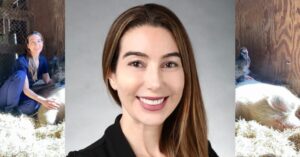

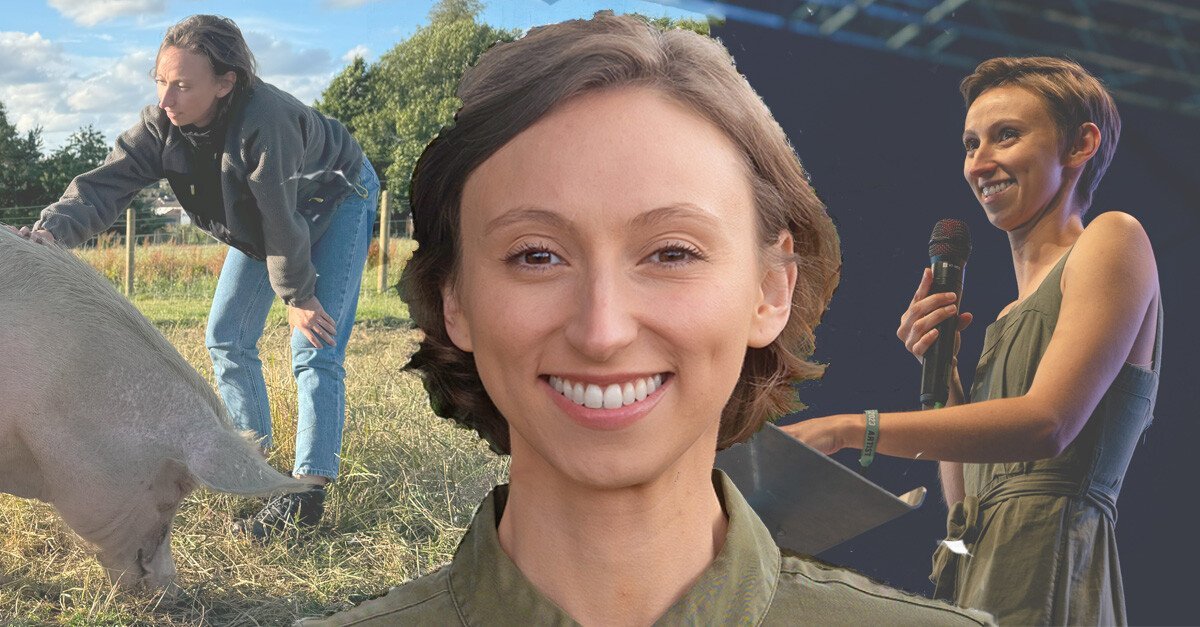
Jordi Casamitjana, the author of the book “Ethical Vegan”, interviews the British veterinarian Dr Alice Brough, who used to work in the pig flesh industry but now is a prominent vegan campaigner
I feel that I know her.
Do you know that feeling when you meet someone you have seen in the media often, which makes you believe that you know this person more than you actually do? Our brains are not wired to deal with people repeatedly seen but never interacted with. In these cases, your brain will make all sorts of wrong assumptions. Sometimes, it will freeze — classically starstruck — while other times it will make you behave in an overfamiliar manner. Sometimes, it will make you mix up their name with someone else’s, and other times it will completely fool you, convincing you that you have met this person before, even if you haven’t.
I had this feeling when I met Dr Alice Brough at the Vegan Wellbeing Weekend in Derbyshire, UK, a couple of months ago. She is a pig veterinarian, who these days, has become a prominent figure in the vegan and animal rights movements because she is now vegan and left her work in the animal agriculture industry to become a whistleblower, a campaigner, and an activist for the animals.
Because I have been in the movement for decades, and now I work writing about veganism and animal protection — which includes writing reviews of vegan documentaries — the image of Dr Brough keeps popping up wherever I look. She has become the vet to go to for most vegan documentaries, and she is a regular speaker at many events (she has been giving talks at the famous Vegan CampOut every year for the last four years). When I met her at the Vegan Wellbeing Weekend she was also part of the Q&A session after the screening of the new documentary “I Could Never Go Vegan” because, guess what? She also appears in it. That’s why, when I met her, I felt that I already knew her.
Her journey from where she started (a full-on meat eater working in the pig flesh industry) to where she is now (a full-on ethical vegan working in the animal protection movement) is quite remarkable, so I thought she would be the perfect interviewee for one of my in-depth articles about important vegans I have had the privilege to interview. Thanks to her lovely companion cat Apricot who this time allowed her to freely talk in a Zoom call without interruptions, I managed to have a nice chat with this famous “vegan pig vet” (as she is often known) that helped me get to know her a little bit better. I’ll share with you some of her amazing stories.
The Vegan Vet (Alice’s Vegan Journey)

How people become vegan is a subject that fascinates me. More often than not it is a long journey that is triggered by a poignant event that awakens people to a reality of animal suffering they had no concept of before. However, that was not my case. I was already working in animal protection for a few years before I became vegan in 2002, so I already knew a lot about the suffering. I had, somehow, compartmentalised it, and I had rationalised my omnivorism. Eventually, my cognitive dissonance cracked, and I was able to get rid of my carnist indoctrination.
Alice’s journey to veganism — and from now on I will call her Alice rather than Dr Brough because she is very friendly and down to earth and, as I said, I feel I know her — is somehow similar. She not only already knew about the suffering of animals well before she became vegan, but working in the front line of animal agriculture, she was aware she had been responsible for such suffering in a much more direct way than the average pre-vegan. However, the difference between her veganisation and mine is that once she became vegan, she was still deep into that world — like a lamb having infiltrated a pack of wolves. Buckle up and be ready to listen to her transformative story in her own words:
“I grew up eating a lot of meat, as that was a very typical thing in my family — our family events were very focused around food. My grandfather was a livestock farmer; he farmed pigs, beef cattle, and turkeys, as well as arable land. I probably ended up eating meat three times a day by the time I was an adult, and never really questioned it.
I had an affinity with animals from a very young age, which is the reason I wanted to be a vet. We had a whole variety of pets in the house when I was growing up. All of my entertainment and weekends as a kid centred around going to the zoo or the local petting farm. So, I was seeing farmed animals a lot, and animals in captivity, and not really questioning it. Then, when I was 15 or 16, I started doing my work experience to become a vet. All I ever wanted to do was be a vet.
I started working on all different types of farms, which involved some of our family friends’ farms. I was quite surprised by how many animals were sick and dying on farms as a regular thing, but because I was moving from farm to farm doing different types of work experience, I think I could write it off as just a kind of one-off, maybe a bit of an issue on that farm, or maybe just this particular season, or something like that.
While I was at school, I did a couple of weeks in a pig farm, just because I was trying to get experience across all the different sectors. My mum was driving me, and she said every time she picked me up I was basically in shock. I didn’t speak the whole journey home.
I remember on the first day I was shown around by this lovely guy who was talking me through it, and we found a piglet that had injured her leg. I asked if we could do something with that, like a splint, or stitch it up. He replied, ‘No, we’ll just knock that one.’ I had no idea what was coming. He just picked this pig up and smashed her head on the floor in front of me. I was just a 15-year-old girl, and I didn’t know what to do. I was the only girl in the unit, so I had to bottle that right up. I just sat on the edge of the farrowing crate. He then showed me how to do it, and I ended up doing that a lot myself.
I went to vet school and there were no vegans there. There were two vegetarian girls in my year who were American and slightly older. I remember we had to do an abattoir day and they started shouting, ‘Meat is Murder!’. They were ostracised for that, and people questioned whether they were fit to be vets — even me.
You are subject to quite a lot of conditioning as you go through vet school. You learn a lot about pets and how to individually care for them to a gold standard — with amazing medicine, surgery, and care — and then the farmed animal side of things is more what can you manage with a small amount of money that a farmer is willing to pay — and how you can you maximise production.
I ended up in the pig industry and I did two years in it before I went vegan. I don’t think I was quite prepared for what I would find on British pig farms. I had hundreds of farms under my care, and it was just becoming more and more apparent that there was nothing good happening. I had all different types of farms, like organic, small family farms that had farm shops attached, right up to massive industrial factory farms. It didn’t seem to matter which section they were in, or which assurance scheme they were under, there was always some horrendous suffering to be found.
I went into veterinary because I wanted to help animals, and I was just having to shoot them every day pretty much, for welfare reasons. It started to affect me very badly. I was taking vet students out with me on calls and seeing how it affected them too.
It was just slowly sinking in. For a period, I was eating only organic meat, but then I was going to organic farms and signing off massive prescriptions for in-feed antibiotics because of the horrendous disease issues they were having. Tens of pigs dropping down, convulsing with meningitis. That’s not high welfare, is it? So, I went through that phase. I can’t remember exactly the moment I stopped eating meat and then became vegan because I think my head was a little bit scrambled, but it was in 2017, seven years ago.
Some people at work knew that I was vegan while some people didn’t. It was more of a subtle thing. I would not have a sausage roll in a meeting, I would ask for some oat milk or buy my own. I’d go to farms, and people would offer me a cup of tea with milk in it. There was a period when I would drink that, but then I got to a point where I would say, ‘I’m gonna need you to throw that away and give me a black tea.’ So, it was a bit of a soft launch.
I got to the point where I thought it would be easier if I just did Veganuary, and then played it off as a health thing. It turned out that it did improve my health significantly in the end. I have a connective tissue problem, hypermobility syndrome, which means that my joints were sore all the time. I would get swollen knuckles when I’d been doing any strenuous work. Then I did Veganuary in 2018 and that constant inflammation just stopped within two weeks of a whole food plant-based diet. From then on, my identity as the vegan pig vet became more known.”
The Pig Vet (Alice’s Veterinary Journey)

Although I know several vegan vets, most of them either work with companion animals or wildlife. Alice is the first vet I met who worked in the animal agriculture industry, so I was intrigued about her journey into veterinary science. Also, I had not realised that a “pig vet” is an actual thing. It seems to be a very specialised field within veterinary practice, and those who become pig vets don’t tend to deal with any other animals as they have their work cut out dealing with all the pig farms which sadly are still scattered all over the country. I wanted to know more details about Alice’s veterinary journey:
“Growing up in the countryside in Derbyshire was very nice. I feel very privileged. My upbringing was very nature-oriented. We were always out on big hikes and my dad was really into birds, bugs, and trees. I remember searching for fossils or creatures all the time. I had a little microscope, and I would look at feathers and leaves. I’ve always had a deep connection with nature.
I had no interest in people. It was always animals. I loved anything scientific, and when I went to school, I was good at science, which worked out well, thankfully.
Before I went to vet school, I worked at this pig farm for two weeks. They thought I was really good, so they offered me a job for six months between school and university, during which I cycled through all the sections — the farrowing house, the weaners, the finishers, breeding, etc. They had boars on site, and I was doing the collection of semen and then the artificial insemination of sows. I got a whole breadth of experience on this farm, which drove my career into pigs because, although looking back it was quite a good farm comparatively, I was shocked by the standard conditions and practices.
It was an intensive farm, and they kept pigs in crates. The mums in cages were the absolute worst. I spent most of my time there, so I got to really know them. You walk in to feed them, and they all just look at you from behind the bars. The misery is absolutely palpable.
Then I had to do ‘litter clipping’. Mutilating all the piglets was one of my jobs, and I think I handled them probably slightly nicer than some of the others might have. I was cutting off the tails of every single piglet on the unit, cutting their teeth with basically wire cutters, and tattooing their ears with these thick needles and dirty paint. Really hideous jobs.
I didn’t like what was happening there. I would sit and watch piglets going about their business all having their little different personalities and preferences, and their mums, in different levels of depression in their crates. It was horrific, some were so obviously depressed. They just would stop eating, and I was trying to get them to eat and stay alive so their piglets would grow enough. Some of them literally just refused to eat until they were skeletal. That is what made me go into the industry because I thought I could help them.
I did six months at that pig farm, and it was very eye-opening. Pretty horrific, but because it was the only pig farm I’d seen, I still thought maybe there were better pig farms. I thought also, naively, ‘This seems like a good thing for me to do, to try and improve welfare standards. I wanted to help pigs.
I then went to Edinburgh University because it was ranked one of the top vet schools in the world at that point. However, in the whole five years, I think we had maybe 10 lectures on pigs. They are not well covered because it’s such a niche area, which was slightly frustrating for someone who already knew they wanted to go into pigs.
After graduating in 2015 I did about a year of mixed practice. Small animals, companion animals, all the different farmed species, horses, and then pigs. I was doing two or three days a week of pigs to start with, because you very much must train on the job. A lot of it is very business-focused, not really what you learn in your degree. It’s more about understanding the industry, productivity figures, certification, how to communicate with farmers, and get them to listen to what you’re saying. Probably 80 to 90% of my work as a pig vet was doing Red Tractor inspections, which would be routine visits. The rest of the time was like firefighting, catastrophic disease outbreaks and welfare problems. Within about six months, I was doing a lot of pig work, and then within a year, I worked exclusively on pigs.
I started in East Anglia, which is a very pig-dense area, and then moved to the South West covering an enormous area. I was in private practice and had lots of different clients, which spanned all the different sizes and systems of farming. Some of the biggest pig producers in the UK were under the practices’ care.
I was always very strong on welfare issues so if there was a problem, I would raise it — whereas I think not everybody would have done so to the extent that I did. If there were pigs that needed to be put down or treated, I would make sure I did that before I left the farm because I didn’t always trust people to do it. I had some quite blunt conversations with farmers, which sometimes landed me in difficulties. Generally, I tried to maintain good relationships with my clients — my farmers — and I did for most of them, but it was really difficult with some of them because I could say the same things 12 times in a row, and they would not do it. I would train them to do what they needed to do, and I told them I would be on hand if they needed me, but still, some just didn’t do it and didn’t care. So, occasionally, some farms did not want me back — because they could choose their vet.”
The Whistleblower Vet (Alice’s Campaigning Journey)

How long can an openly vegan vet work in the animal agriculture industry? I suspect not that long, so I was surprised to learn that Alice managed to stay for two years. However, there is not much you can do in an environment in which people not only don’t take your philosophy seriously but may even regard you as the “enemy” who has somehow infiltrated their domain. In Alice’s case, eventually, things became too difficult.
“As time went on, and as I became vegan, I had clients move to other vets. My veterinary work never changed. I stayed exactly the same for four years, I didn’t do anything differently as a vegan vet, but I think people felt more threatened by me because I was not buying their products. Even though I was the same person that they’d worked with for years. It just became more of a difficulty.
I also think my mental health was not okay. It was just day in and day out witnessing absolute horror. I was trying to hold it together doing and seeing horrific stuff and having to compartmentalise it completely. It was taking its toll, for sure.
I just got to the point where I thought, ‘I’m not helping the pigs.’ I wasn’t. I stayed so long because I felt like I couldn’t leave them as I knew that I was doing my best. I was really trying, but then I realised I was not achieving that much because I could say what the farmers should be doing, but if they were just going to do the complete opposite when I left, and I could only be there for a couple of hours every few months, I was not making a big difference.
Meanwhile, animal protection groups were doing investigations of farms that I knew — and lots of other pig farms in the UK — and I thought that what they found was indeed what was going on behind closed doors. I had seen worse, actually. I’ve never been presented with investigation footage that is worse than what I saw on farms at pre-arranged inspections. Even the ‘high welfare’ farms can be hideous. And I was doing slaughterhouse work as well — there’s no objectively humane way to slaughter a pig.
I went through a bit of emotional turmoil as to what the best thing for me to do was because I’d trained for so many years, but eventually, I left the industry. I first thought that maybe I’d go and get a job at DEFRA and be an inspector, or maybe I’d get a job at the RSPCA, but then I thought that people would not believe what was happening to these animals and how much they’re suffering. So, I thought, ‘Maybe I’ll just try and tell people that.’ However, I had no plan for how to do it.
I was seeing investigations happening and I was seeing lots of campaigns on pigs, but then I was also seeing limitations in campaigning and maybe some slight inaccuracies. I was thinking that there was a lot more they could be saying. I thought I’d love to just weigh in and add professional weight to that campaigning.
Then I went to an event and saw Juliet Gellatley from her vegan campaigning organisation Viva! She mentioned the Hogwood documentary she was producing, and I thought I would have a crack at that. Having had no media training —I’d done nothing but veterinary training my whole life — I went to Juliet, and I said, ‘Firstly, do you want me in your documentary? Secondly, have you got a job for me?’ She thankfully said yes to both questions, so I went to work for Viva! in Bristol.
I stayed there for six months until COVID happened, and I learnt about the vegan movement and how it all functions. My role was veterinary consultant and campaigner. I worked within the campaigns team but also tried to add veterinary weight to things. I was still doing a little bit of veterinary clinical stuff, just with pigs in sanctuaries and rescues.
While working with Viva! I was offered to give a talk at a vegan fair, and as soon as I started writing it, I thought, ‘Wow, that’s amazing.’ It was like an exorcism, and I sobbed while I was writing this 40-minute talk. In this vegan fair, there were probably like 80 people — and people crammed in the back standing — so, I thought, ‘I should probably do more of this. This seems to be a thing that works well; telling the story.’ I’ve given many talks since.”
The Omnipresent Vet (Alice’s Activism Journey)

I keep seeing Alice everywhere in the vegan movement because there is a lot that a vet who worked in the animal agriculture industry can say. This is why she was the perfect expert interviewee for documentaries such as Hogwood: A Modern Horror Story (2020), The End of Medicine (2022), Pignorant (2024), and I Could Never Go Vegan (2024), and for many educational and inspirational talks (some of which can be watched on her YouTube channel Vegan Pig Vet). However, the other reason for her omnipresence is that she is very good at all of this. She comes across as very natural and relatable, and the stories she tells are very well-written.
She is a full-on vegan activist now, participating in marches and protests, doing street vegan outreach, veganising other people, giving inspirational speeches, and doing online activism. However, her expert testimonial is perhaps the most valuable aspect of her activism — and I am saying this from the position of someone who has been in the movement for decades. She explains how she ended up in the current activism phase of her life:
“I left Viva! and then immediately the COVID lockdown happened. I was out on a limb, but it felt quite good because I’d been thinking, ‘There’s so much going on, so many different groups and people that I’d like to work with.’ I felt like I had so much to do and say, without really any idea of what I was doing. I spent the lockdown getting to know everybody in the animal protection movement and doing lots of Zoom calls. I got to know everybody, and everybody got to know me. I tried to help with anything that involved pigs or farmed animals, anything to do with the environment, human health such as pandemics, and all that.
At one point, BAFTA-winning film director Alex Lockwood got in contact. Someone in a documentary that he had almost finished saw me do a speech outside DEFRA, which was on all sorts of things but mentioned pandemics and antimicrobial resistance, and sent it to Alex. He contacted me and asked if he could interview me for his documentary “The End of Medicine”.
Joaquin Phoenix and Rooney Mara were executive producers, and apparently, Joaquin liked one of the scenes we filmed in my shed. I also had a lot to say on the topics, so we ended up doing about seven days’ worth of filming, and I narrated bits of the documentary too. It became this whole lockdown project. I think the film’s amazing. It got tipped for an Oscar by Variety magazine. We did lots of little podcasts and interviews to promote it.
I left the industry so I could tell the stories of the pigs and for the pigs, so I started just doing more talks. For the Vegan CampOut talks, I tried to give material that would be useful for people to use in outreach or to share. These were more like motivational and inspirational talks. However, I think my niche is reaching audiences that nobody else can, so the veterinary profession and, to an extent, the industry. Seeing if I can make any ‘defectors’. That’s been interesting.
Right now I am involved in a movement-wide campaign for the RSPCA to drop their RSPCA-Assured scheme because it’s welfare-washing. They’re pushing this idea that they are giving animals a life worth living and a happy life and their products are safe to buy because it’s ‘high welfare,’ and they’re making money off that. Having had a lot of RSPCA’s assured farms under my care, I can categorically say that they’re not ‘high welfare.’
I’ve got lots of things going on at the moment, much of which happens behind the scenes. I’ve got legal cases on the go, and I consult on lots of farm and slaughterhouse investigations. I review the footage and pick out what you’re seeing in terms of disease or welfare issues, or legal breaches. Ah, and I’m also writing a book right now.”
I am looking forward to reading the book Alice is writing. I know it will be great because she has so many important things to say — and she says it all so well (she has a Patreon page too if you want to support her). The more her voice is heard, the more truth about what humanity is doing to animals will be revealed. The more she is listened to, the more people from the animal exploitation industries and the veterinary profession will change how they approach animals. The more her expertise is used, the more credibility the vegan, animal rights, and environmental movements will gain.
We have become friends now — and I am quite sure this is not my brain tricking me — and I expect I will keep seeing her popping up all over the place.
I am looking forward to it.
Sign the Pledge to Be Vegan for Life: https://drove.com/.2A4o