
Jordi Casamitjana, the author of the book “Ethical Vegan”, writes about his experience having visited the legendary Camp Beagle in Cambridgeshire, England, the longest-lasting animal rights protest camp in the world
It was a rainy and windy day — and that’s not a cliché.
When I took the train to Huntingdon, Cambridgeshire, about an hour from London, where I live, I knew the weather would not be with us that day. A storm was sweeping the British Isles from North to South, so the issue would be “when”, rather than “if”.
“That’s not a big deal,” you may think. “At least you are not in a tornado or hurricane-prone area,” you may correctly point out. This is true, but I was not going to an event where I could easily shelter from the elements. I was going to be out in the open, exposed to the elements. I was planning to spend several hours in the middle of a road, and I did not know what to expect.
I was picked up at the station by Dr Alice Brough, the amazing vegan pig vet I interviewed recently who suggested the trip to me. She drove us a few miles Northeast, and then we turned onto the B1090, a relatively narrow road crossing agricultural fields around the village of Wyton. We could not see it from the road itself, but when you look at the road on Google Maps, you can spot an anomaly. Among the fields, there is a big cluster of buildings that look out of place. A succession of long warehouses or industrial units, arranged in a linear and rectangular layout covering about 8 acres. The site is bordered by trees and vegetation all around, which seem to serve as natural barriers, and to keep the whole place hidden from the ground view.
However, before we arrived at what would be the discrete entrance of this secretive facility, I already knew what was just about 200 metres from us, because of what we could see on either side of the road: portable toilets, tents of different colours, banners, signs, traffic cones, and orange plastic barriers with reflective strips. We had arrived at Camp Beagle, the longest-lasting protest camp set up by animal rights activists in June 2021 outside of MBR Acres, a breeding facility for beagles used in vivisection, still ongoing.
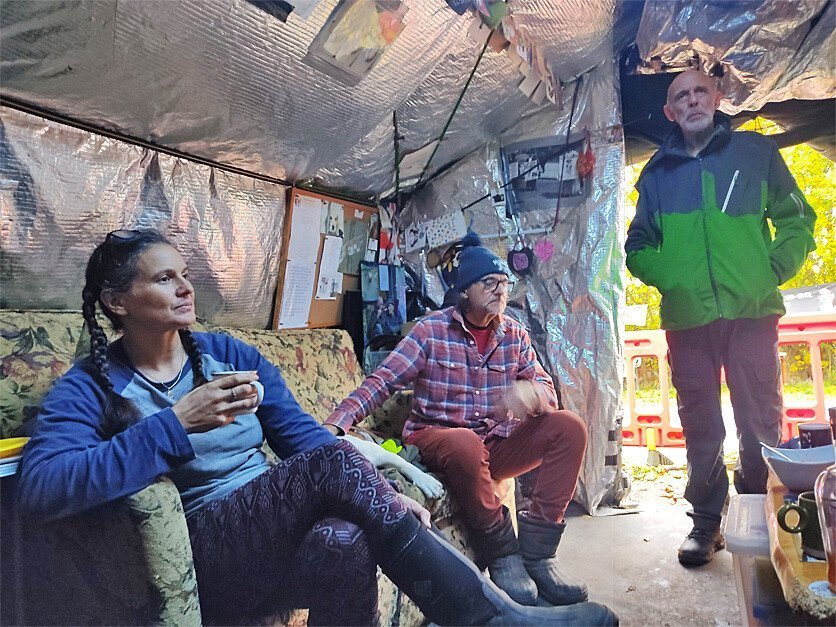
We parked the car on the side of the road, about 100 metres from the camp and proceeded to walk through the narrow muddy improvised path, under the noise of powerful wind shaking the surrounding trees. We were greeted by Sole, who took us to the main tent where we met John, Lindsey, and Dave (as well as Milo, Billy and Pepe, some of the friendly canine residents). After having heard about this amazing record-breaking camp for years, I was finally going to see it with my own eyes.
The Reason for Camp Beagle
Camp Beagle is not set up in a field. It’s set up along the ledge of a relatively narrow two-carriage road, so there are only a few metres of available space on either side and can only grow along the road, not by going into the adjacent fields (which are private property). Therefore, it is a “long” camp set on the local council’s highway land that ends about 10 metres from the main entrance of MBR Acres.
Since 2018, MBR Acres has been owned by the American company Marshall BioResources (MBR), and thousands of beagles are bred at the facility each year to be sold at the age of around 16 to 20 weeks to vivisectionists around the country and abroad, who will use them for drugs and chemical toxicology testing, as well as research experiments. We have been told that the dogs’ internal organs and blood are also sold. The facility keeps over 1,200 dogs on site at any one time and supplies about 2,000 puppies a year to toxicology testing laboratories across the UK.
Marshall BioResources has subsidiaries in multiple countries around the globe, but one of the most notorious facilities was an Italian Green Hill puppy farm, which was owned by them until it was shut down for animal cruelty in 2016. The prior owners of the Wyton site were Harlan Laboratories UK Limited, and before them Interfauna (originally called Hacking & Churchill) both of which also used the facility to breed animals for testing and medical research — and they also became the target of animal rights protests and direct action operations. So, this site has been a hell for animals tortured in labs for almost 50 years.
John Curtin, one of the permanent residents at Camp Beagle, was already involved in some of those early campaigns, so it was great for me to meet him in person and learn more about the reasons behind the camp. I asked him the question, “Why are you here?”
“Good question. Why am I here? It’s so simple. I’m here because of violence, lies, corporate greed, government cover-up, cruelty, torture, fake science, money, compassion, kindness.
The real revolution. I went to prison 30 years ago for raiding this place. I’ve got a history with this place. I went to prison for 18 months for the crime of rescuing 82 beagles and 26 rabbits from here. We’ve come back to finish the job. It’s an old-school protest camp, we are going to stay here until this place is gone. Never give up. It’s not a slogan, it comes from the heart, deep. So, we’re here, we’re a real thing.
Our posts get hundreds of thousands of views now. This company, they’ve spent 50 years hiding. Now they’re known all over the world. But we’re here also, we’ve reached people across the world through social media. But we’re a boots-on-the-ground project too. We’re part of the local community.
No one wants this place. They hid it away, now we’ve outed it and it’s just a matter of time. In the 3 years and 4 months we’ve been here, they haven’t been able to provide one single person to go in front of any camera. They can’t find anyone in the world that would defend this place.”
An Organically-Grown Protest Camp
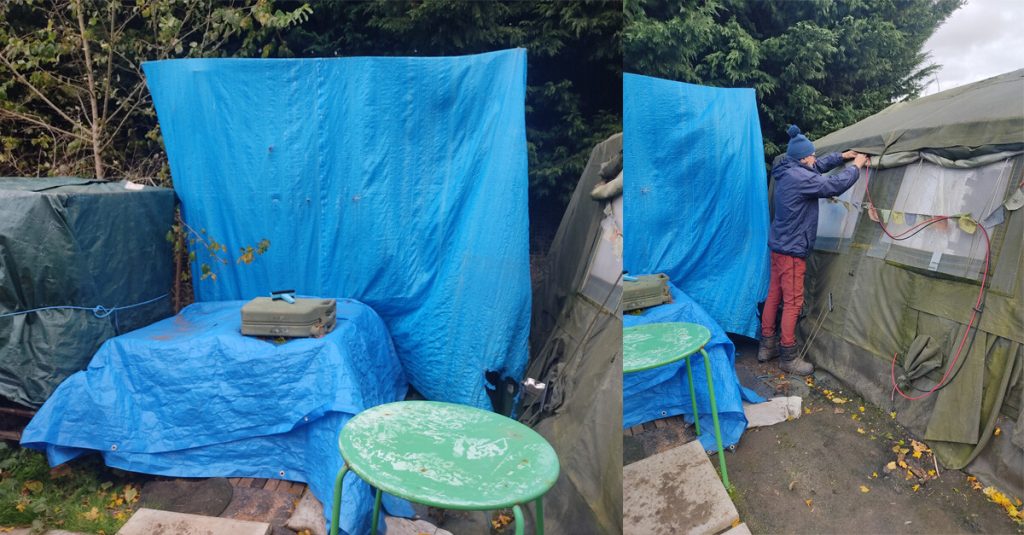
The camp is now like a small village. It has three big army tents where they have the main living and sleeping quarters, several other tents where they have the kitchen and keep materials/provisions, two external portable toilets, a water tank, a shower, solar panels, batteries, generators (so they have electricity most of the time) internet access, and a heating system. It has been organically growing over the years, and it is far more comfortable than I imagined, thanks to all the volunteers who built it, and the many supporters who help to maintain it with donations and assistance. It does really feel like a home, mostly because of how nice, friendly, generous, and welcoming its residents are — anyone who has visited can probably remember that being offered a cup of tea or coffee was about the first interaction they had with Camp Beaglers.
Although I knew that the current campaign started in 2021 after the activist group Free The MBR Beagles obtained footage inside the perimeter fence, I have often wondered how the actual camp started. Well, I didn’t need to wonder anymore, because I could ask John now. He said the following:
“Three years and four months ago, if you’d had asked me, did I want to take part in this project, did I want to come and live on the side of the road for three years, in the mud, and the cold, and the wind, listening to these dogs screaming? No way. No chance would I have signed up for that.
When I joined the movement in the 80s, vivisection was at the top of the animal rights agenda. For one reason or another, it went off the agenda. But the good old animal rights people kept it going. People here, just like it is now, without the camp, people used to come maybe once a month. A few people, imagine it, in the wind, in the rain, sending away banners, not many cars passing, but it kept it alive. And in one of those demos, one woman heard the dogs and said, ‘I can’t leave.’ So, she stayed the night, and then the news got around, and then a few more people came and said, ‘I heard about it.’
My initial reaction was, ‘Oh no, they set up a camp. If I go to that camp, I’m going to get stuck.’ Look what happened, I came, and I’ve never left since. So, completely, ridiculously organic. It’s got a life of its own.”
The logistics of how to run a camp like this interested me. The army tents are spacious and sturdy, so they resist the wind and they don’t leak. Thanks to donations they now have insulation, so when the heat is on they become relatively comfortable living spaces even in winter. The day I visited they were planning to install a new solar panel much higher because the one they were using had limited access to the sun due to the tree cover, but they decided to do it another day due to the heavy winds. John explains more about all of this:
“Everything you see, solar panels, the water. Look at this, this is our shower. This is a perfect example. People walked from Scotland, and they built it with the money they raised. There’s no Camp Beagle crew as such. People just came, they walked from Scotland, I repeat, they walked from Scotland, and they built that. So, people come and add their input to it.”
I also wanted to know who is in charge and who makes the operational decisions. John and Dave, another resident who comes and goes spending a few days at the time, told me that nobody leads. John said, “It’s so headless. We haven’t got a committee. That comes with its own kind of dangers and it’s hard to keep a lid on things. Decision making, Dave, what about Camp Beagle’s decision-making?” Dave replied, “It’s torturous. We have to do meetings every week. People come to a tent in a couple of weeks, come up with something, everybody goes away, has a think about it, and the next meeting it comes up again and we end up with a resolution, don’t we? It’s a rolling thing.”
However, living at Camp Beagle can also be very hard. I experienced the strong wind which even ripped apart one tent donated by an animal rights group, but that is nothing compared with what the residents have had to endure. One day, they even found everything frozen solid because the temperature reached minus nine Celsius. I asked John about the hardest day they experienced:
“That minus nine was severe, wasn’t it? That was the hardest day. We’ve had hurricanes, but these are army tents, and they’ve got these slots, so there’s a bit of movement in them. We’ve had floods. We’ve had snow. Snow loads, yeah. Heat waves. I’d say the worst is the wind. The wind is the bigger destroyer.
Remember we started off in small little tents, three little tents by the side of the road. There’d be lorries going, and I had to choose. ‘If I’m going to get hit by a lorry while I’m sleeping, do I want it to go over my legs or my head?
And pot noodles. So now we’ve got the full kitchen, we can have roast dinners on a Sunday, but we started off with a little camping gas and pot noodles were what we used to cook.”
The Other Residents of Camp Beagle
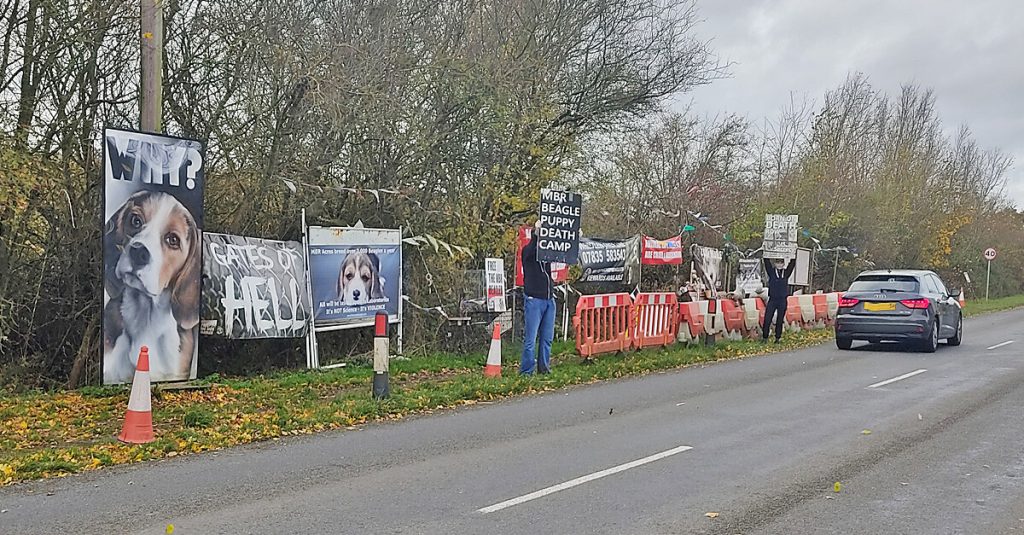
During the day we spent at Camp Beagle, several activists joined us. Some were semi-residents who spent some time in it, while others were visiting for the first time, like me. They took some of the signs and held them along the side of the road so the vehicles passing would see them (like a classical protest). I was pleased to see how many passing vehicles tapped their horns in solidarity. The visiting activists brought food and treats to share (Alice and I included), so after some time holding the signs, we all sat in the comfortable three settees in the main army tent (well insulated with a silvery plastic lining) and ate some cake and chocolate.
The number of people who have been part of Camp Beagle has changed over time. There have been moments when more than 100 people were at the camp (for specific events), but there has always been someone in it 24/7, as otherwise, the police would clear the site. Even at night, someone is always sleeping in the main tent, where an alarm will sound every time a vehicle goes through the MBR Acres’ gates — so the protestors can bear witness to any truck with beagles coming out, as well as monitor the movement of workers.
I asked John who the residents of Camp Beagle are, and he said, “Who really is Camp Beagle? The people here today. You’re part of Camp Beagle, whether you like it or not. Especially the people who have put work in in the past month, or people who are prepared to put work in this month. So, it’s a rolling thing. There’s no leadership, there’s no structure as such. It’s difficult to explain. Proper anarchistic kind of thing, you know? We’re literally at the side of the road. Anyone can come in. We’ve had the kettle on for three years and four months.”
I was pleased to see that Camp Beagle is a vegan camp. As I have been vegan for more than 20 years, I expected it to be, but vivisection is such an atrocity that even non-vegans have campaigned against it — so it was not outside the realms of possibility that the camp would have been run by some of these. John told me that veganism forms an important part of the camp’s philosophy:
“We’ve got a vegan kitchen now. We don’t talk about veganism a lot in our posts, but it’s a core part of our principles. For me, the dogs, kind of represent the ambassadors for the chickens and the pigs that also never get to see the sky, never feel a drop of rain. Dog cruelty breaks most people’s hearts.
I like a quote from Leonard Cohen, ‘Everything’s got a crack in it, it’s how the light gets in.’ So, kind of our job is to break people’s hearts here. It’s a place of tears, I’ve already seen people crying today. And it opens people up to the message. Good old kindness, and compassion.”
We should not forget the most important residents of Camp Beagle. The hundreds of Beagles trapped inside MBR Acres. Because it was a very windy day when I visited, we could hardly hear them that day, but the most permanent residents often do (barking, howling, and crying). However, they told me that in recent months, they seem to hear them less, perhaps because they have moved many to the further warehouses of the site, perhaps because the company is experiencing a temporary breeding lull, or perhaps because they may be discretely phasing down operations — nobody at Camp Beagle really knows, but they can only hope.
The Legality of Camp Beagle

Camp Beagle is a legal camp. It is not trespassing on any private property and the local highway authority has inspected it several times, directing the residents about what they need to do or change. The current policy of Camp Beagle residents is not to break the law so they can stay as long as possible — until MCR Acres shuts down.
However, there have been legal issues in the past, and as the breeding facility does not want the camp there (MBR Acres has spent £3-4,000,000 in legal fees to present a case in the High Court to remove Camp Beagle), clashes have led to convictions. Sole Iriart, one of the long-term residents, explained to me that now they have become a kind of legal “noisy neighbour” who does not interfere with the facility’s work, there is no legal reason to ask them to leave:
“They are operating as normal, with very noisy neighbours who will report everything they do, any kind of suppliers that come here, as long as they’ve got their label on. We can see how many workers they have. If they’ve got more workers or fewer workers. We can see if they’re taking puppies out or not taking puppies out. We’re just like the neighbour from Hell, that’s how we tend to describe ourselves.
If people were to interfere, which was what happened at the beginning, blockade the gates, and do lots of kinds of direct action, they soon would arrest them. A woman got arrested and banned for 10 years from being here. So, if we all start doing those kinds of actions, we’re all going to get arrested and taken away; no more camps.”
However, there is a High Court injunction that prevents Camp Beagle’s residents from protesting within 10 metres of the main gate of the facility or blocking vehicles’ movements (hence all the traffic cones and plastic barriers, to delimit the injunction area). This is relatively good because MCR Acres wanted a much more restrictive injunction (one that would make it impossible to have a camp there), but a judge denied it and ordered a much better one, which essentially legitimises the existence of Camp Beagle as long as the named activists in the injunction do not cross the 10-metre limit. Sole explains more:
“There is an injunction that includes persons unknown. At some point, we had one hundred and something people. On the injunction, they were asking that nobody came here for one mile around, except one day a week, and that 10 people would be allowed between 12 o’clock and 1 o’clock on Fridays to stand between this line and that line. They wanted to allow one demonstration a year, a maximum of 100 people, only for one day a year. And we just battled against it. We were lucky to have a fair judge, who is always talking about the rights to protest and the rights to exist — because they are a legal company with a licence and everything.
He decided that the main area of conflict — and he was right — was the gate, as the workers were coming in and out. So, now we are excluded from the gate, 10 metres on that side, 10 metres on this side, and 10 metres forward. So, it’s like a vortex area, where the people whose names are on the injunction should not go. It covers unknown people, but, you know, some cyclists pass here, there are normal workers that pass here, and they’re breaking the injunction, so they don’t tend to apply it for the unknown. Some people come and demonstrate also, but us, who are here all the time, we cross the road, walk over there, and then cross the road again, so we do not breach the injunction.”
However, there are still open legal questions regarding the injunction, and whether it has been breached by some of Camp Beagle’s residents, that a judge has to decide. There was a six-week trial in April last year, but the judge has not given a final judgement yet.
A Life of Suffering
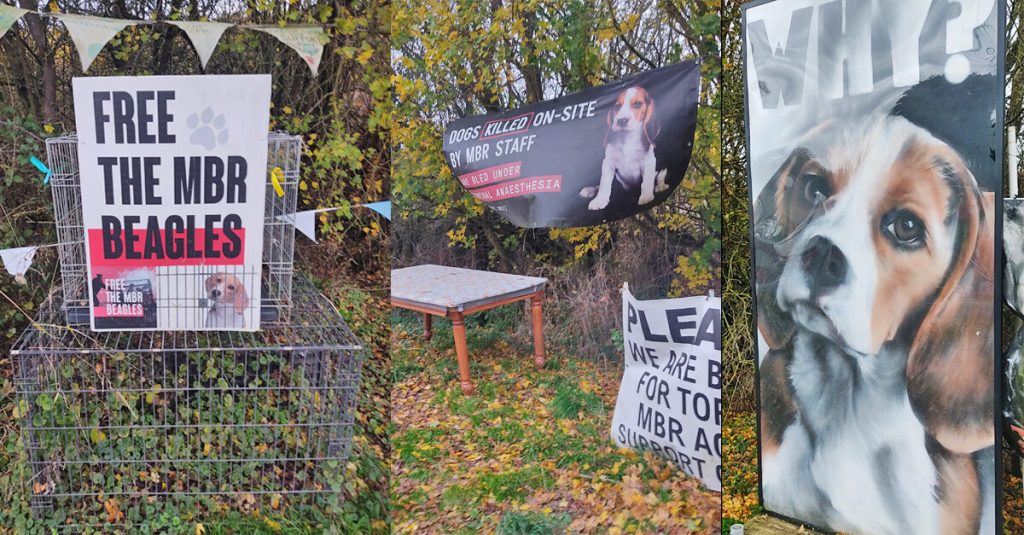
Beagles are the dog breed most often used in lab experiments and tests because of their intermediate size and forgiving nature. Thanks to animal rights activists who went beyond camping outside MCR Acres and managed to record what still goes on inside the facility, the public now knows the kind of life the poor puppies suffer at the centre, before being sent to be tortured in vivisection labs.
The pens in which the beagles spend all their time have no access to natural light or stimulation. They just wait for the next meal fed through automated hoppers directly upon the floor and water fed through metal “nipples”. Inevitably, the beagles’ mental health deteriorates under these poor captive conditions, which can be proved by the stereotypical behaviours (such as pacing or circling) investigators recorded.
When the puppies reach around 20 weeks of age, they are sold to labs and transported in crowded vans to a miserable short life of repeated toxicity testing. Customers include Labcorp in Huntingdon and Harrogate, Sequani in Ledbury and Charles River in Tranent, Scotland — which is a 6-8 hour journey.
Also, Camp Beagle says that MBR Acres have a live donor colony which may be bled up to four times a month, to a maximum of 15% of their circulating blood volume, typically from the jugular vein (these dogs may be used for several years to produce blood that will be sent to other labs). Additionally, MBR Acres does bleeding out (or exsanguination) of dogs under terminal anaesthesia. It has been reported that harvesting organs for sale to researchers is also part of the business model.
The other problem at MCR Acres which Camp Beagle has exposed is how many hours the dogs are left unattended, with only security staff present at the facility. The dogs are left unattended 20 hours a day at weekends and 16 hours a day during the week. On weekends, workers go home early. I visited the camp on a Sunday, and this is what John said to me:
“Let me just remind you what’s going on, there’s no one in here now. There are only security guards. The workers left at 11 o’clock today. It’s a factory. There’s no one in there to look after the beagles.”
After having repeatedly complained about this abandonment (something which would not be allowed in any kennel or other facilities keeping dogs) the company now, tokenistically, sends some workers about 3 PM on Sundays to just look around for 45 minutes, and then go home — which clearly would be an insufficient time considering the size of the premises, the number of dogs to check, and the time they would need to change clothes. Indeed, I witnessed this the day I visited, as the alarm of the main tent sounded at 15:00 and 15:45. The number of staff at MCR Acres decreased from 41 in 2017 to 21 in 2022, so fewer staff per dog means it’s less likely that the dogs receive the care they deserve. To guarantee minimum animal welfare standards, veterinary surgeons and care staff should be on site 24/7, but they are not, abandoning the stressed dogs in the facility as if they were inanimate goods that can be switched off after working hours.
It’s Only a Matter of Time

In 2023, there were 2.68 million scientific procedures on living animals carried out in Great Britain, and the number of animals used for the first time was 2.61 million in 2023 and 2.69 million in 2022. Also, in October 2023, the Animals in Science Regulatory Unit (ASRU) of the Home Office renewed the MBR bleeding licence for another 5 years so that ex-breeding bitches/studs, grade B pups, etc. can be legally bled out (by cardiac puncture under terminal anaesthesia) and their blood and organs can be sold.
However, although these facts and numbers are depressing, the good news is that the pressure against vivisection keeps growing, and the alternatives to animal testing are becoming more numerous, better, and more accepted. There is no longer an excuse for animal tests, and we begin to see some positive steps toward their eventual abolition. For instance, in 2022, California’s Governor Gavin Newsom signed a bill that, from the 1st of January 2023, banned the testing of harmful chemicals on dogs and cats. California became the first state in the US to prevent companies from using companion animals to ascertain their products’ harmful effects (such as pesticides and food additives). This year, US President Joe Biden signed into law the FDA Modernization Act 2.0, which ended a federal mandate that experimental drugs must be tested on animals before they are used on humans in clinical trials. This law makes it easier for drug companies to use alternative methods to animal testing. The UK has fallen behind on all of this progress, but hopefully, it will catch up.
John believes that the days of MCR Acres are numbered. He said, “The tests that they get sent for are the same tests that the chemical industry invented 70 years ago in order to sell all their products. Insecticides, pesticides, food ointments, all the chemicals we use; all the pharmaceuticals. These tests haven’t changed a bit. You’re using a mobile phone. Imagine how much computer capacity has changed in 70 years. There was hardly a computer 70 years ago that would be the size of a cathedral that could add 2 and 2 together. That phone you’re holding in your hands has more computer capacity than the entire NASA space missions of the 1970s. Yet, the tests that these dogs get sent to haven’t changed one bit in 70 years. It’s not science, we’re calling it out. That’s why I’m saying it’s kind of frustrating knowing that this place is going to be shut down. If we all go home, if we all stop protesting, it’s on the way out. There’s no one talking about the future of animal testing. It’s immoral. It’s cruel. It doesn’t work, that’s the main thing. I wish we could have stopped this because of morality, because of the cruelty, but we’re going to stop it through science, through the fact that it doesn’t work. It’s lies.”
John is right. Animal testing does not achieve the scientific and safety objectives that have justified it for decades, it serves only as a bureaucratic rubber-stamping exercise. Animal experiments do not reliably predict human health outcomes. The National Institutes of Health acknowledges that over 90 % of drugs that successfully pass animal tests fail or cause harm to people during human clinical trials. In 2004, the pharmaceutical company Pfizer reported that it had wasted more than $2 billion over the past decade on drugs that “failed in advanced human testing or, in a few instances, were forced off the market because of causing liver toxicity problems.” According to a 2020 study, more than 6000 putative medicines were in preclinical development, using millions of animals at an annual total cost of $11.3bn, but of these medicines, about 30% progressed to Phase I clinical trials, and only 56 (less than 1%) made it to market. Also, reliance on animal experimentation can impede and delay scientific discovery as drugs and procedures that could be effective in humans may never be further developed because they did not pass the test with the non-human animals chosen to test them.
The Beagles Are Not Forgotten

The Camp Beagle website has a lot of information about MBR Acres, vivisection, and events at the camp. Sole told me about the next one:
“We have an event on the 21st of December, when we are marking two years since Animal Rising liberated 20 beagles, and we are also marking that this will be our 4th winter outside MBR Acres. We are inviting everybody who has ever had any involvement with Camp Beagle, or anybody who has never been to Camp Beagle before, to come and join us on that day, or any other day that suits you, to mark the liberation of these 20 Beagles, and to mark the hard work that loads of people have put to keep this camp going, and keep the protest going against the breeders of beagles for animal laboratories.”
The Camp Beagle website also reads, “We can’t do this without your much-valued support, be it arranging your own outreach, telling your friends, family or work colleagues, sharing our social media posts, donating or just visiting the camp.”
I loved the few hours I visited the camp, and I was very humbled by its work. The people I met were extremely kind and generous, and I could feel their compassion and decency glowing. Camp Beagle is an amazing place and has already achieved quite a lot. It helped produce covert footage exposing the desolate conditions of the beagles bred for vivisection; it ran two successful petitions leading to recorded parliamentary debates; it has gathered crucial information about the activities of the facility; it got 41k online followers and coordinated national outreach events; it forced MBR Acres to spend about £4m of legal costs in one of the UK’s biggest high court injunction litigations (money they can no longer invest in torturing animals); it has been housing many activists who wanted to fight for the beagles on the ground; and it has been speaking for Beagles and other victims of animal tests keeping the anti-vivisection movement alive.
A very remarkable achievement of Camp Beagle’s has been breaking the record of the longest-lasting animal rights protest camp. With over 3 years of 24/7 protest against vivisection and bearing witness to how vivisectionists work, Camp Beagle is one of the most successful grassroots protests I have ever seen. As a nagging subconscious that does not let you rationalise away your responsibility, every worker involved in MBR Acres — be it an employee, a contractor, or a supplier — passing by the camp is constantly reminded of how wrong what they are doing is, and how they cannot hide away from it.
However, I think the most important achievement is that, from all the millions of animals bred for torture in vivisection labs around the world, the sweet innocent beagles around Camp Beagle are the ones who always had friends nearby who never forgot them. Friends who knew who they were and how much they suffered. Friends who constantly fought for them by their side.
I hope the beagles felt their presence.
Sign the Pledge to help Make Animal Testing History: drove.com/.2zoc