
The coconut industry of Thailand may still use captive monkeys, forcing them to work to collect coconuts, making any product that uses any of said coconuts unsuitable for vegans.
Coconuts are one of many people’s favourite fruits.
Although coconuts are often associated with tropical foods that Westerners mainly eat when on holiday, these days, many products contain coconut (not only for food and drink but also for fibre). Many vegans consume coconuts in the form of plant-based milk alternatives to animal milks, and vegan cheeses or yoghurt. However, any well-informed ethical vegan who has been vegan long enough is very careful in selecting which coconut products to consume, because not all coconuts are suitable for vegans. Coconuts from Thailand that come from companies that source them from farms or operators that keep monkeys captive and force them to work to collect them would be unsuitable for vegans, as any exploitation of animals to produce any product renders it unsuitable.
The unfortunate victims of this type of servitude are the pigtailed macaques (Macaca nemestrina). There are two species of this Asiatic primate. The Southern pigtail macaques are found in northeastern India, southern China, Indonesia (Kalimantan in Borneo and Sumatra), eastern Bangladesh, Burma, Thailand, Laos, Malaysia, Cambodia, and Vietnam. Northern pigtail macaques are found in peninsular Thailand, through Burma and Indochina and into Bangladesh, India, and Southern China.
Farmers in Thailand have been using pigtail macaques to pick up coconuts for some 400 years as they are faster at doing so than humans, and can reach places in the palm trees people would find difficult to get. Monkeys can pick up to 1,000 coconuts a day while a human can pick about 80. However, to exploit this monkey labour, monkeys have to be taken from the wild or bred in captivity, and they are kept captive in horrible conditions (often restrained in chains or ropes) and forced to work against their will. Academics believe this custom started in Malaysia and Indonesia and arrived in Thailand before the 1800s.
Monkeys Suffering for Coconuts
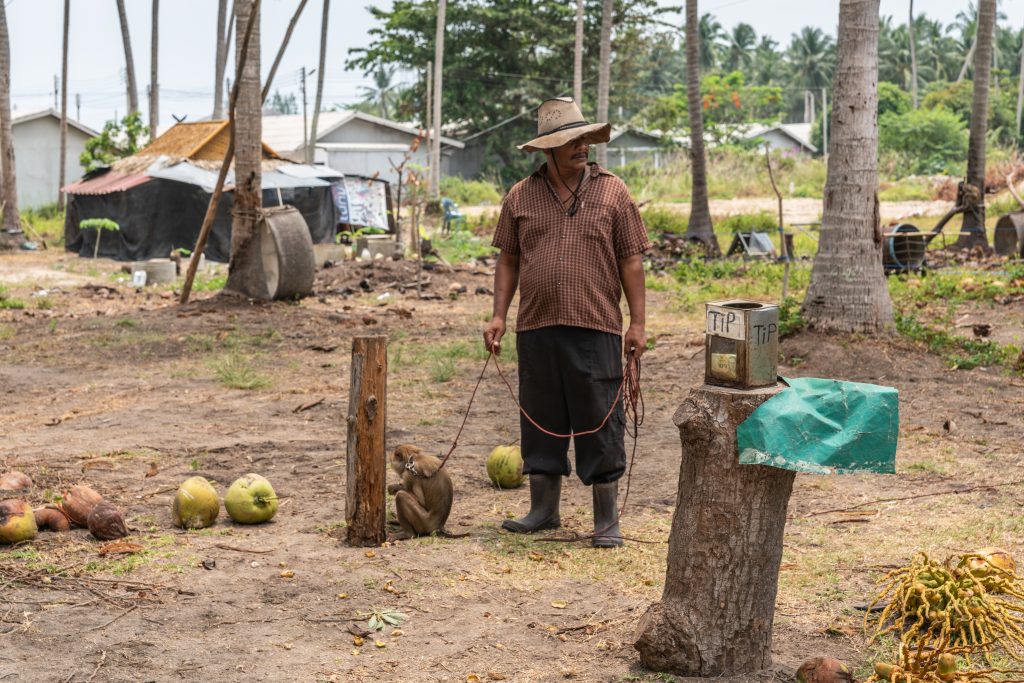
In 2021, the number of monkeys used in the coconut industry was estimated to be 3,000. About half of those were thought to have been caught in the wild, whilst the other half were captive-bred.
Keeping nonhuman animals captive against their will, especially wild animals, is inherently cruel as it deprives them of the space, stimuli and choices they evolved to have and make, but in the case of monkeys forced to work for people, there are additional problems that can cause even more suffering.
In nature, macaques live in large, highly social groups with strict hierarchies, but when taken into the monkey labour business, juvenile monkeys are caged and kept away from other members of their species. Monkeys in training are kept chained with rigid metal collars around their necks, which causes them a great deal of distress. Handlers use intimidation and abuse to teach them to obey. When their “training” is complete, the monkeys are sold to coconut pickers. While the monkeys are climbing trees to collect the coconuts (tied up with a rope to prevent escape), they are frequently bitten by ants and stung by hornets, which can be fatal. The animals sometimes incur broken bones from falling out of the trees or being violently yanked down by their handlers.
On other occasions, the monkeys may be abandoned in the forest, even though they lack the skills needed to survive on their own after being bred in captivity or kidnapped as juveniles.
Exposing the Monkeys’ Servitude

Not all coconut-producing countries or companies use monkeys to collect coconuts. Thailand is the only country today that still uses them for commercial coconuts that will be traded, but not all the coconut companies in the country use them. However, it’s difficult to find out if they do or not because they may claim that they do not if they want to appeal to foreign customers. The only way to be sure is to investigate them, and this is what the animal rights organisation PETA did after hearing that Chaokoh, one of the most popular coconut milk brands, said they only used monkey-free coconuts.
In 2019, PETA said they had found eight farms in Thailand where monkeys were forced to pick coconuts for exportation around the world. That year, PETA Asia investigators visited all of the farms in Thailand that exploited monkeys, including those for Chaokoh, as well as several monkey-training facilities and a coconut-picking competition. PETA said they witnessed monkeys pick coconuts for people and “documented that these sensitive animals were abused and exploited.” Laura Shields, PETA’s director of corporate responsibility, said in an interview with Axios, “Now the push is to just stop sourcing from Thailand entirely and source from other places that produce coconut milk without the use of monkeys, like the Dominican Republic, India, Sri Lanka, Vietnam, and the Philippines.”
The owner of one “monkey school” that investigators visited admitted to buying from farmers who use nets to kidnap wild infant monkeys from their homes and families, which is illegal in the country.
A 2020 audit by a Thailand-based firm said that the coconut company associated with the first investigation no longer used monkeys in picking coconuts, but a new PETA Asia investigation the same year found that monkeys were still being used at many farms, that monkey training centres were still in operation, and that coconut-picking competitions using monkeys were still taking place.
For eight months, from December 2021 to July 2022, PETA Asia conducted its third investigation into Thailand’s coconut industry, including a video narrated by actor and animal advocate Peter Egan, in which chained monkeys are seen spending long hours climbing tall trees and picking heavy coconuts. In response to international criticism following the release of PETA Asia’s two previous related investigations, the Thai government and companies that produce coconut products have claimed that monkeys are no longer being used in the making of exported products – but PETA Asia’s latest investigation confirmed that rampant abuse of primates was still going unchecked and that Thai coconut industry insiders are deliberately hiding monkey labour in their supply chains.
Boycotting Monkey Coconuts
Following PETA Asia’s investigations, more than 45,000 stores, including Albertsons, Kroger, Publix, Target, and Wegmans, stopped purchasing Chaokoh’s products.
In June 2022, Walmart, the American multinational retail corporation that operates a chain of hypermarkets, discount department stores, and grocery stores in the United States, announced it had stopped selling Chaokoh’s coconut milk following two undercover investigations by PETA.
In April 2023, HelloFresh announced that it would stop sourcing coconut milk from Thailand due to concerns over monkeys being used to pick up coconuts from palm trees on farms in this country. HelloFresh is a publicly traded meal kit company based in Berlin, Germany, and whilst it is the largest meal-kit provider in the United States, it also operates in Australia, Canada, New Zealand, Europe and Japan. By then, Walmart, Costco, Target and Kroger had already stopped carrying coconut milk from certain Thai suppliers known to exploit monkeys, but HelloFresh decided to stop buying coconut milk from the entire country as reports suggested that the use of monkeys is more common than previously thought. This is significant because Thailand had approximately 80% of the market share for coconut milk in the US.
In May 2024, the UK Supermarket chain Co-op agreed not to source coconut milk from Thailand because of the common exploitation of monkeys in the country’s coconut industry. From then on, Co-op’s own-brand coconut milk was sourced from Sri Lanka, where monkey labour is not used to harvest coconuts as it is in Thailand, and stocked in 2,400 UK stores. PETA asked the company to extend this policy to include branded Thai coconut milk products and urged everyone to avoid buying any coconut products sourced from Thailand due to the rampant abuse involved in their production.
With Thailand being the tenth biggest coconut-producing country in the world, vegans can be reassured that, even if they boycott any Thai coconut product, they will still be able to enjoy others originating from the other nine countries.