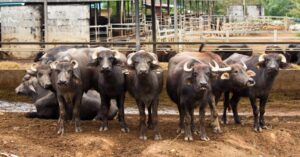

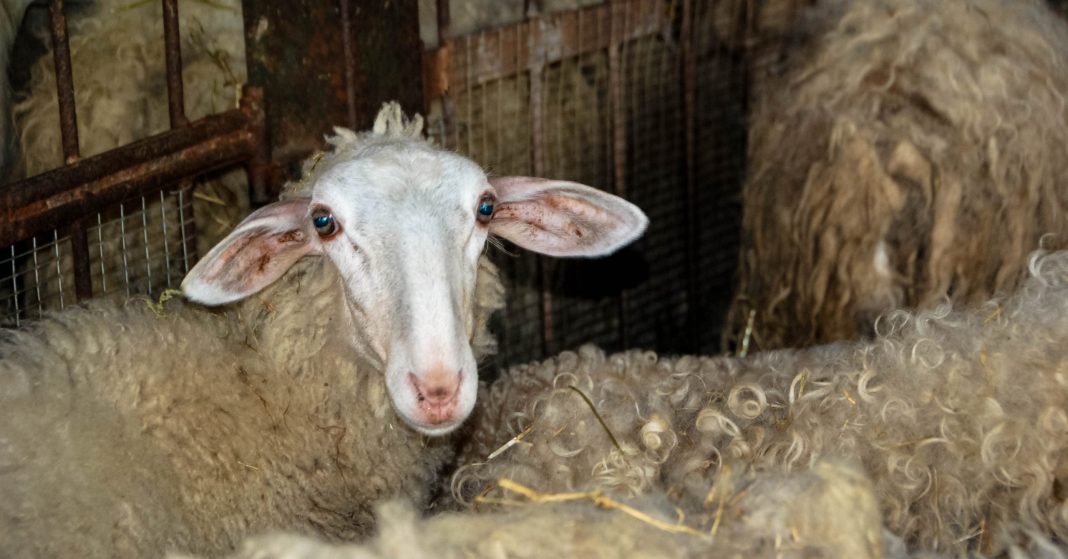
Live sheeps exported by sea face numerous threats to their health and well-being.
Each year, millions of sheeps are forcibly transported by sea as part of the live export industry. This is not only wrong because the reason for such transport would be the sheeps’ certain death (as they are exploited for their flesh), but also because these long voyages add additional suffering to these very sensitive animals. Investigations have shed light on the severe physical and psychological distress sheeps experience during transport by sea.
Sheeps are among the most commonly transported live mammals in the global live export trade, which subjects them to weeks or even months of confinement in overcrowded ships, where their welfare is ignored by both the farmers who send them and the workers who transport them or will receive them when the ships land — as they see them only as walking flesh that does not yet need refrigeration as the living body prevents it from rotting.
Sheeps exported by sea are typically packed into cargo holds with barely enough room to lie down. These holds are often hot, humid, and poorly ventilated, creating conditions ripe for heat stress, dehydration, and disease. During these voyages, sheeps are exposed to extreme temperature fluctuations, from stifling heat to chilling cold. Many succumb to exhaustion, dehydration, or disease, and their bodies may be discarded into the ocean. The mortality rate for sheeps during sea transport is alarmingly high, with thousands dying before reaching their destination. However, in the end, even those who survive the journey will be slaughtered soon after arriving.
In 2018, a whistleblower provided videos showing the horrific conditions aboard the farmed-animal carrier Awassi Express. During a voyage from Australia to the Middle East in 2017, 2,400 sheeps died of heat stress. Veterinary care on these ships is often inadequate or non-existent, leaving sick and injured animals to suffer without relief. The stress of transport combined with the unnatural and unhygienic environment leads to outbreaks of disease, adding to the death toll.
A study of 53 live sheep export journeys between 2018 and 2023, carrying 2.5 million sheeps, revealed shocking statistics: 80% of reports indicated sheeps were starving on board, at least 60% reported animals suffering from heat stress, and more than 6,551 sheeps died during these voyages.
And then, we have the accidents. The Danny F II sank off Lebanon in December 2009, resulting in the deaths of 10,224 sheeps. In November 2019, more than 14,000 sheeps drowned after the Queen Hind vessel capsized near the port of Midia, Romania. In June 2022, the farmed-animal carrier Al Badri 1 capsized off Sudan, resulting in the drowning of 15,100 sheeps. There have been seven total losses of farmed animal carriers in the past decade, leading to the deaths of 50,000 animals.
Beyond the ethical issues, the live export industry also has significant environmental repercussions. The transportation of live sheep by sea contributes to greenhouse gas emissions and ocean pollution, further exacerbating the climate crisis.
Sheep Transport by Sea Was Very Common

Today, at least 2 billion live animals are exported each year globally, whose bodies are believed to be worth $22 billion. Every day, at least 5 million live calves, cows, bulls, sheeps, pigs, goats and horses are routinely transported by sea, rail, air, or road across continents. According to data from the UN’s Food and Agricultural Organization (FAO), the number of live farmed animals being exported has grown dramatically over the past half a century. Almost 2 billion live chickens were transported around the world in 2017 (compared with 950 million ten years earlier).
Although the concept of live animal exports is not limited to transport by sea, in the case of sheeps, this is probably the most common method of transporting them alive, among other reasons because Australia, a country that for years was one of the top sheep exporters, is an island.
In 2020, 777,798 sheeps were exported by sea from Australia. The mortality rate for sheep exported by sea from Australia in 2020 was 0.224%, which was 15% lower than the 2019 mortality rate of 0.26%. In the early 2000s, Australia’s live sheep trade transported by sea about 5 million sheeps a year, mostly from Western Australian farms, but the number gradually declined. In 2023, Australia exported 684,000 sheeps, worth about $50 million, mostly to the Middle East (a trip in which the animals are confined in ships for about two weeks). Kuwait, Israel and the United Arab Emirates were the main destinations.
Around 3 million sheeps were estimated to have been exported by sea from Romania alone in 2020. In 2019, 121,974 tonnes of sheep and goats’ live bodies were transported by sea from the European Union to third countries. Other countries that export sheeps by sea are Spain, Portugal, France, Turkey, and Lebanon. There are also landlocked countries such as Jordan and Hungary that export sheeps by sea via a third country (which means that the sheeps have to endure several transportation methods before arriving at their destination).
Banning Live Export of Sheeps by Sea

New Zealand banned live sheeps exports by sea in 2003. When Saudi Arabia rejected a shipment of 57,000 sheeps that year, resulting in a living nightmare for these animals, public opinion shifted. In 2007, the live export of bovines for slaughter was also banned but exporting them for breeding purposes was still allowed (this created a loophole farmers have been exploiting). However, New Zealand officials finally said that the country would phase out all live exports by sea by 2023. On 16th July 2021, the Ministry for Primary Industries (MPI) advised the animal protection organisation SAFE (leading the campaign against live exports in the country) that the export of live animals by sea would be allowed to continue only until 30th April 2023.
On 2nd July 2024, the Australian Senate passed legislation to phase out live exports of sheeps by sea. The Export Control Amendment (Ending Live Sheep Exports by Sea) Act 2024 prohibits exporting live sheep by sea from Australia from the 1st of May 2028 and creates a provision of $107 million to help the industry adjust to the change.
Dr Jed Goodfellow, Australian Alliance for Animals spokesperson, said to Mirage News, “This legislation has been a long time coming for our members and their two-million-plus supporters who have been calling for an end to this cruel and unnecessary trade for decades. The tireless campaigning by advocates, in particular, the groundbreaking investigations by Animals Australia, and the courageous efforts of whistleblowers who risked their careers and more to expose the conditions faced by Australian animals onboard live export vessels, have finally been acknowledged today. We thank the Albanese Government for following through with its election commitment and promise to the Australian people, and we thank all members of parliament who voted for compassion and stood on the right side of history today.”
In May 2024, the UK government passed the Animal Welfare (Livestock Exports) Act, which prohibits the export of live animals, including sheeps, for slaughter and fattening from Great Britain.
Join millions choosing vegan in 2025 with Veganuary! https://bit.ly/Veganuary25