
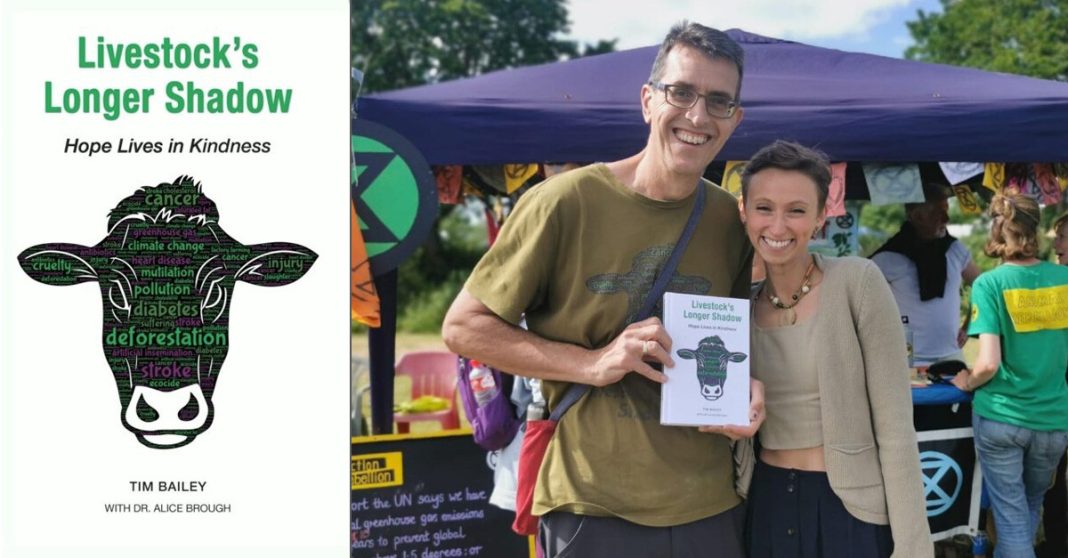
Jordi Casamitjana, the author of the book “Ethical Vegan”, reviews Tim Bailey’s book “Livestock’s Longer Shadow” dealing with the damage UK animal agriculture causes to everyone and everything.
I heard about it when it was published in 2021.
As part of my current profession as a writer of blogs and articles on issues related to animals, veganism, and animal protection, I also write reviews of movies, documentaries, and books. However, I normally do that the same year they have been published or premiered. This time, though, I will break this habit, as I will write a review of a book published three years ago.
There are several reasons for that. Firstly, I was already aware of the book when it was published because I wrote a news article at the time mentioning its author. The article was titled “River Pollution From UK Animal Farms Is So High That Farmers May Have to Reduce Production”, and in it, I quoted its author, Tim Bailey, saying, “Many catchments are already at or beyond the capacity of the environment to cope, and more will follow unless we take unparalleled action… In some instances, it will entail the reduction and restriction of livestock production or the treatment and export of organic manures.”. The book Tim published on the 15th of November 2021 was titled “Livestock’s Longer Shadow: Hope Lives in Kindness”, and I was made aware of it when I read an article from The Guardian interviewing him.
However, at that time, I thought the book would only be about river pollution, and that it probably simply advocated for reducetarianism (I have written often about how I am not keen on the reducetarian concept or identity). I was very wrong. The book is about much more. With an avalanche of relevant data, it brilliantly tackles all of the issues vegans like myself are constantly talking about. It covers in great detail animal exploitation, health, the environment, and much more, and does not advocate for reducetarianism as I so thought, but for veganism (as Tim Bailey has been an ethical vegan like me for a few years now). I know that because at the end of the book, there are a few chapters written by other people, and one of the contributing authors, Dr Alice Brough, who I interviewed recently, gave me a signed copy of the book. Not only that, but she introduced me to Tim Bailey himself, whom I had the privilege of meeting on a Zoom call. I soon realised that we have many things in common.
Well, we have more things in common now, as he has read my book, and I have now read his. I was so impressed by the magnitude of the research he did to fill the densely packed 369 pages with data. Reading this incredibly useful reference book about the wrongs of animal agriculture, I thought I should write a review of it, even three years later than usual (although the book remains completely relevant and poignant now so that delay does not matter).
A Health Journey to Veganism

Tim Bailey is what I would describe as an expert on many issues related to animal agriculture. He is one of the UK’s most prominent farm regulatory pollution experts, with a distinguished thirty-year career from a field officer to senior national advisor. He studied at the University of Plymouth and has a BSc (Hons) degree in Environmental Science, specialising in geology and hydrogeology; and is a Chartered Waste Manager (MCIWM) and a Chartered Environmentalist (CEnv). Tim is also a researcher, conservationist, horticulturalist and specialist natural history author with several published titles sold worldwide (several on carnivorous plants, a subject I find ironically suited to a vegan). As his website states, “Tim lives in Somerset, England, and is an advocate for sustainable agriculture, rewilding, animal kindness and for a whole-food plant-based diet.”
When I write articles about interviews I made with prominent vegans, I always start asking them about their vegan journey. I did not need to ask this of Tim because he has a long chapter in his book titled “My Journey”. The first of the 30 subchapters is titled “A Stroke of Luck” as one of the pivotal moments of Tim’s journey toward veganism was a stroke he suffered at 7 A.M. on the 2nd of February 2016. He recovered, and on the way, he adopted a plant-based diet.
This chapter not only covers his personal health journey but also expands into broader topics related to veganism and health. Meticulously, it goes through all the negative health problems associated with eating meat and other animal products, and all of the health advantages of adopting a fully Wholefood Plant-Based Diet (WPBD). This is another thing he and I have in common because this is the type of vegan diet we both follow.
I thought I already knew everything there was to know about this issue, but Tim’s book taught me many things I did not know (and provided me with useful data for the things I did know). I found his discussions about proteins particularly illuminating. This is an extract from the book in which Tim discusses some interesting — although unethical from a vegan perspective — 2020 studies by Raubenheimer and Simpson:
“In a five-year experiment on mice, they found the same relationship, with mice kept on a low-protein, high-carbohydrate diet living longer. The authors noted that it was a combination of low protein and high carbohydrate that promoted the longest lifespan, not protein alone. In human terms:
‘This would be the equivalent for us eating less meat, fish, eggs but more healthy carbs, like low-calorie vegetables, fruits, beans, and whole grains.’
A low-protein, high-fat diet didn’t give as long a lifespan as the low-protein, high-carbohydrate diet either. Where the high-protein diet had the advantage was in reproduction. The extra protein produced a more endowed male mouse and female with a bigger uterus to carry a larger litter. The authors termed the two dietary pathways the ‘longevity pathway’ and the ‘growth and reproduction pathway,’ with the latter meaning ‘make hay while the sun shines and to hell with the consequences.’”
The Pollution from Animal Agriculture

Chapter three shares the book’s title, and, unsurprisingly considering Tim’s expertise, it is the most detailed chapter on the pollution animal agriculture causes. It is focused on the UK, where Tim has worked, but it makes references to other countries as the situation is very similar. The amount of detail is staggering, and it must have taken many years to research. I knew animal agriculture pollutes the soils, rivers, and other waterways, but I did not know all the ways it does so (slurry leakage, silage leakage, ammonia emissions, soil erosion, etc), the details of how each of the types of farming (sheeps, cows, pigs, farmed birds, fishes, etc.) are contributing to it, and the amounts involved. The whole thing is quite worrying.
I found particularly interesting the analysis of how any regulatory attempt to prevent such pollution is failing by either design or implementation and how the amounts involved are so big that it looks as if the regulation is no longer fit to tackle the problem. On the issue of slurry pollution, this extract from the book reflects the urgency to apply an effective solution:
“Slurry pollution occurs on most farms and compliance with environmental law and codes of good agricultural practice is generally poor. I provide more information on this in the next section. Slurry pollution is growing, with reported pollution statistics no longer representative on their own of the actual pollution happening. It is not true in my experience that the majority of livestock farms are high environmental performers, as the industry wants to, and does, promote. They are not; the majority cause and/or contribute to pollution. Until farms put in the right infrastructure to prevent all forms of pollution, slurry pollution will continue to grow in proportion to livestock intensification. Until then, we are well and truly in a slurry emergency.”
I was surprised by the significant role infrastructure plays in contributing to the problem. You would expect that any industry that generates a dangerous byproduct should find a way to contain it safely, but it seems that one of the characteristics of the animal agriculture industry is that every container where they put the polluting byproducts leaks because it’s either too old, too small, or too inadequate. This industry not only is cruel to sentient beings and deceptive to the public; it’s also messy, wasteful, and irresponsible (which is an impression many people may have after visiting an average animal farm).
The Climate Crisis

Throughout the book, Tim not only describes the problems by offering the most up-to-date data and analysing it in detail so it can be interpreted correctly, but it also debunks many myths and destroys many of the arguments that the animal exploitation industries put forward to defend their appalling practices and deceive politicians. One of the major battles where this misinformation takes place is in the climate crisis arena. Animal agriculture is one of the major contributors to the current global climate crisis, but the industry always tries to downplay its contribution to greenhouse emissions and exaggerate the effects of any initiative it puts forward aimed at reducing it. Tim does a great job of challenging this. Here are some extracts from this chapter.
“Agriculture is a major source of greenhouse gases, with methane (CH₄) largely arising through enteric fermentation of ruminants (cow burps) and from animal manures; nitrous oxide (N₂O) losses from manufactured fertiliser and organic manure applications; and carbon dioxide (CO₂) from fertiliser manufacture and other fossil fuel use. Disturbance of soil and land-use change (e.g. deforestation and grassland conversion to arable) are also contributing factors.
In 2017, UK greenhouse gas emissions were estimated at 460.2 million tonnes of carbon dioxide equivalent (MT CO₂e). The estimate is the sum of seven greenhouse gases covered by the Kyoto Protocol. Of the seven, three are of importance to agriculture: carbon dioxide, methane and nitrous oxide. Together they contribute 45.6 MT CO₂e, approximately 10 per cent of all UK greenhouse gas emissions (CO₂, CH4, and N2O: 5.6, 25.7, and 14.3 MT CO2 respectively), with about 72 per cent (33.03 MT CO₂e) of that associated with the livestock sector.”
One of the most useful things I found in this book is that it helps you to correctly interpret the data that is out there. It always gives useful context and warns you about how making some comparisons may lead to misleading conclusions. Here is an example:
“When less carbon-efficient regions are mentioned, please remain mindful that a large reason for this is that they are carrying out land-use changes (e.g. deforestation) to accommodate their livestock, which the UK did a long time before 1990 and therefore is not included in the UK greenhouse gas inventory. Furthermore, the carbon footprint of soya bean meal imported from South America to feed livestock is attributed to the place of origin and not to the receiving country.”
The book not only focuses on the problems but also offers solutions, all of which gravitate toward shifting animal-based agriculture to plant-based agriculture. This is an extract in which Tim explains how to move the UK to not only a vegan nation in terms of diet, but to a Wholefoods Plant-Based Diet nation (as this is the healthiest vegan diet):
“For a UK-wide WFPBD it may be necessary to convert some permanent pasture to arable land, but that does not mean ploughing up the land and releasing large quantities of CO₂ and nitrate. Land-use change can be managed sensitively, but there would inevitably be a temporary mix of gains and losses as we move towards a new equilibrium. New crops, and increased hectares of more specialised crops such as lentils, soya bean, hemp and quinoa, already grown in the UK, along with other protein crops like amaranth, will be needed to lower food imports.”
Individual Animals Matter

The final chapters of the book are dedicated to the different farmed animals that are exploited in the UK, and what happens to them. This is a subject I know well as I have written often about it, but I will certainly use Tim’s book to write further articles, as it compiles all the necessary information in chapters easy to find with the relevant references (the book lists the citations at the end of each chapter, which makes it easy to be used as a reference text that can be consulted after reading it).
Not only does the book have subchapters for each type of farmed animal (cows, pigs, chickens, turkeys, ducks, sheeps, rabbits, and fishes), but it also has subchapters on some specific practices, such as slaughterhouse work or the transport of live animals. Very comprehensive indeed.
One of the interesting elements of these chapters is the stories of some individual animals, mostly lucky ones who escape their grim fate by being rescued, which reminds us that animal rights are all about the individuals, not the species.
After this subject, we find the contributions of other authors. Dr Alice Brough, the vegan pig vet, writes a poignant chapter titled “Pig Farming — Facing the Truth” describing her experience working four years as a pig vet in the UK and witnessing horrible things happening to pigs (which eventually made her quit and become a vegan activist). Her chapter — which made me cry — is much longer than the other contributors, so her name also appears on the cover of the book, and the author page. Then, we have shorter contributions from Eloise Bailey, who wrote a chapter titled “Confronting Cognitive Dissonances and Speciesism”, Dr Shireen Kassam, who wrote a chapter titled “Plant-Based Health”, and Sivalingam Vasanthakumar, who wrote a chapter titled “Giving up Livestock Farming—sheep”. These experts not only give important information but show it from a first-hand testimonial perspective that gives more credibility to both of their arguments and those Tim uses throughout the book.
The book ends with an unequivocal vegan message: “We have merely made livestock farming a necessity through the choices we have made. We only farm animals because we want to eat meat, fish, eggs and dairy, not because we have to; and as a consequence, we are okay with being unkind to animals. We do not have to eat animals, wear animals, stand or sit on animals or sleep in or under their clothes. We can be kind to animals instead, and by doing so, be kind to ourselves and our planet.”
Livestock’s Longer Shadow is an excellent book that I think all vegans who do vegan outreach in any form should keep, as it will become an important reference book that you can use for data to back up any claim or debunk any myth about relevant issues of farmed animals, diet-related health, and environmental destruction. I am very impressed with the amount of data Tim managed to collect and organise in a useful way for the reader. This book makes veganism very credible, so pre-vegans who read it may likely be persuaded to make the final step.
Before I read it, I thought the book was about pollution. When I got it and read the table of contents, I realised that it was about veganism and the wrongs of animal agriculture using the UK as a case study. However, after I finished it, I realised it is indeed all about pollution. Not only is animal agriculture polluting our soil, rivers, and oceans but also animal exploitation is polluting our bodies and minds with carnist ideas that make people ill and cruel.
Fortunately, we, vegans, know how to cleanse everyone and everything with a simple solution: the vegan world.
Join millions choosing vegan in 2025 with Veganuary! https://bit.ly/Veganuary25