

The meat and wool industries routinely castrate the lambs they breed, which is a form of mutilation that causes a great deal of suffering
The practice of castrating lambs is a routine procedure in the meat and wool industries, two industries that are very intertwined, often justified by claims of improved meat quality and easier management. However, it is just another type of mutilation (like tail docking in pigs) that causes suffering to these animals.
Farmers exploit the sheeps they keep, trying to produce as much profit as possible, so they will most likely use them for lamb (baby sheep meat), mutton (adult sheep meat), milk, and wool. Although lamb meat may generate most of the profit from a flock, it is not the case that wool is just a by-product of the meat industry, because the sheeps used are genetically modified to produce more hair, not to become big and fat (like in the case of pigs genetically modified by the meat industry). Therefore, both the meat and the wool industries operate in tandem equally exploiting the sheeps, none being a subsidiary of the other. Both industries are responsible for the practice of lamb castration.
Castration is primarily justified to prevent unwanted pregnancies in mixed-sex flocks and to avoid “ram taint,” an unpleasant taste in the meat caused by testosterone. Additionally, castration reduces aggressive behaviour among male lambs, making them easier to manage in a farm environment.
Lambs are subjected to all sorts of painful procedures from a very early age. Just weeks after birth, their ears are perforated, their tails are chopped off, and the males are castrated often without any painkillers. Male lambs are castrated when they are between 2 and 8 weeks old, either by making an incision and cutting their testicles out or with a rubber ring or other devices used to cut off blood supply.
According to the 2011 NAHMS study, 68.5% of US sheep operations castrate ram lambs (60.0% small operations and 94.9% large operations). Only 38.3% of operations castrated lambs when they were 7 days of age or younger.
How Lambs Are Castrated
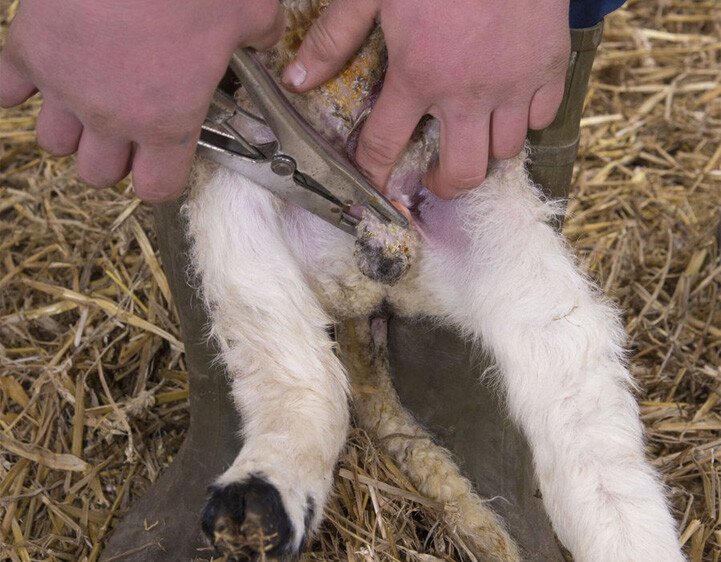
Several methods of castration exist, including rubber rings, emasculators, and surgical removal. Each method causes lambs suffering. The American Veterinary Medical Association (AVMA) stated that all methods of castration cause acute and chronic pain.
Rubber Rings (Elastrator): This method involves placing a tight band around the scrotum, cutting off blood supply until the tissue dies and falls off. It is painful and can cause significant stress to the lambs. It is often performed without administering painkillers, despite the fact it is one of the most painful methods in terms of duration and intensity. Sometimes, the testes are pushed up inside the body wall and the ring is applied below the testes to produce a “short scrotum.” A short-scrotum ram produces testosterone, but not sperm.
Emasculator (aka The Burdizzo): This tool crushes the spermatic cords with so-called haemostatic tongs without breaking the skin, which can also be painful and distressing. Each cord is clamped separately. Sometimes, the Burdizzo results in incomplete castration. Small lambs are harder to do. It is often performed without anaesthetics or painkillers.
Surgical Method: This involves cutting open the scrotum to remove the testes, posing risks of infection and severe pain. The bottom third of the scrotum is cut off with a knife or scalpel and the testes are pulled out. The wound is allowed to drain naturally.
Sometimes, the rubber ring and clamp methods are combined (the cords are clamped immediately before or after the application of the ring). There is also immunocastration, where an injection is used to prevent the release of the gonadotrophin-releasing hormone (GnRH).
In the US, the 2011 study mentioned earlier found that banding was the most common method of castration, employed by 87.5% of US sheep operations, while 34.5% used a surgical knife to castrate ram lambs.
Research has questioned some of the justifications for castrating sheeps, and it has shown that male lambs reach slaughter weight more quickly and produce leaner meat if not castrated.
The Laws About Lamb Castration

Across Great Britain, lambs under 3 months old may be castrated by a stock keeper, such as a farmer or shepherd, but lambs over 3 months old and adult rams must only be castrated by a veterinary surgeon. In the UK the Animal Welfare Acts 2006 legally restricts mutilations unless they are carried out for medical treatment. However, some mutilations are exempt from the ban on the basis that they can be necessary for long-term welfare or animal management reasons, control of reproduction, or identification purposes. The laws in the UK allow for castration using a rubber ring or other device to constrict the flow of blood to the scrotum on animals aged not more than seven days. When any other method is used, an anaesthetic must be administered when the animal is aged three months or over. The Prohibited Procedures on Protected Animals (Exemptions) (Scotland) Regulations 20076 allows for castration and tail docking but does not specify the method or apply age restrictions.
In the US, there are no federal laws specifically regulating lamb castration. Industry standards and state-level regulations generally guide practices. Most states allow castration without anaesthesia if performed at a young age (typically within the first few weeks of life). The American Veterinary Medical Association recommends castration be performed as early as possible, preferably within the first week of life. It also says, “Castration and its associated negative welfare implications can be avoided in some management systems where males are separated from females before puberty and intact animals are slaughtered at lighter weights.”
Canada has national codes of practice for the care and handling of sheeps that state Castration should be performed as early as possible, preferably within the first week of life, but for lambs older than 10 weeks, castration must be done with pain control.
Australian legislation (Prevention of Cruelty to Animals Act) states that castration must be performed on lambs as early as possible, and no later than 6 months of age. If castration needs to be done to sheeps older than the prescribed 6 months, the operation must be carried out by a veterinarian using pain relief and haemorrhage control.
In 2023, the Indian central government issued the Prevention of Cruelty to Animals (Animal Husbandry Practices and Procedures) Rules 2023, which mandate that procedures like castration of bulls, horses, and sheeps be done with the involvement of a registered veterinary practitioner and using general and local anaesthetics instead of the prevalent painful methods. The new rules state that the castration of sheeps shall be performed at as early an age as possible using anaesthesia and analgesia under the recommendation or supervision of a registered veterinary practitioner and where practical, the animal shall be castrated before the optimal age, i.e. in the case of sheeps and goats, eight to twelve weeks of age. It states that the castration of an animal shall be done in the following manner:
(a) the animal shall be blindfolded and humanely handled before and during the procedure;
(b) general and local anaesthetics shall be given to animals prior to castration, irrespective of the method used;
(c) during anaesthesia, the animal shall be placed on soft ground on lateral recumbency with the head elevated;
(d) castration through surgical method shall ensure Halsted’s principles and castration through physical method using Burdizzo clamp to ensure strict asepsis, and
(e) post-procedural analgesics shall be given to animals under the recommendation or close supervision of a registered veterinary practitioner.
In the EU, procedures resulting in the loss of a significant amount of tissue or the modification of bone structure, or which cause a significant amount of pain or distress are forbidden, but there are exceptions, such as castration by surgical methods or with haemostatic tongs. The EU directives state that castration, in particular by the use of rubber rings, should be avoided, but if it has to be carried out, only surgical methods preceded by anaesthesia or haemostatic tongs should be used.
The castration of lambs is just another mutilation like tail docking or debeaking performed for human convenience with total disregard for the moral rights all nonhuman animals possess, so it should be banned as well as any practice inflicted on farmed animals against their will.
Take the Vegan Pledge: https://drove.com/.2A4o