
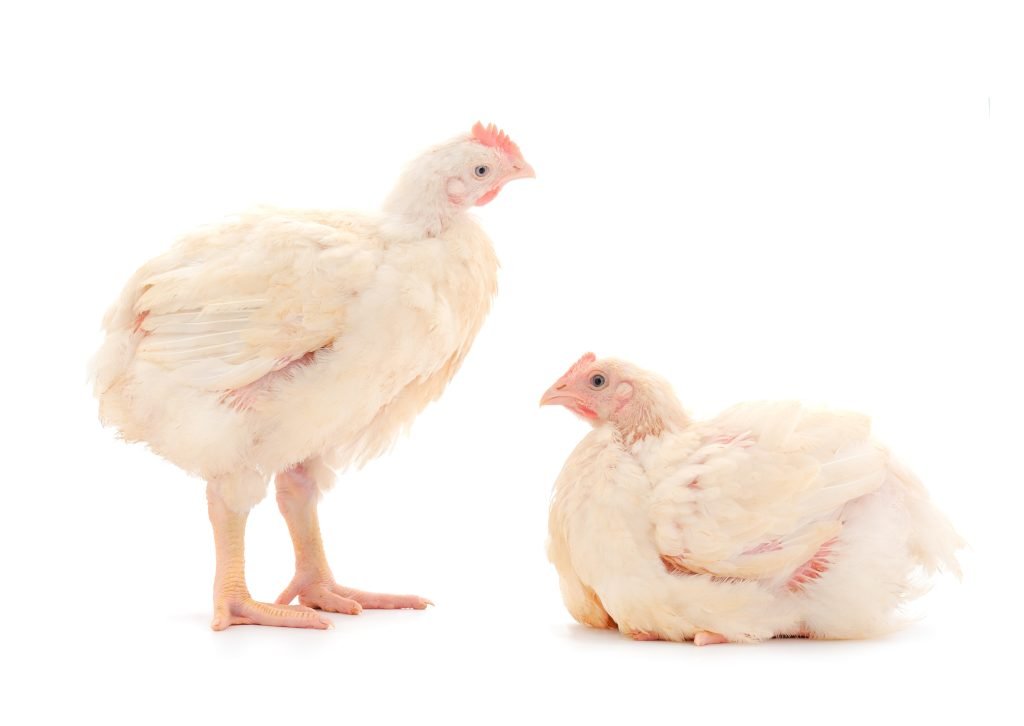
The animal agriculture industry is fattening broiler chickens, bred for meat, through genetic manipulation and by feeding them abnormal food.
More chickens are suffering now than ever.
The animal agriculture industry breeds two types of chickens, egg-laying hens for the egg production industry and broiler chickens for the meat industry. The latter have become an increasingly popular source of food and the number of chickens killed now continues to increase while the number of many of the other animals bred for food is declining. There are about 1 billion broiler chickens slaughtered in the UK every year, 9 billion in the US, and at least 66 billion every year in the world since 2016.
This rise has been caused by an increase in efficiency in the way broiler chickens are exploited, which has allowed the production of more meat with lower costs, so chicken meat has become relatively cheap in many countries (also helped by government subsidies).
The most important change the broiler chicken industry has made over the years has been increasing the amount of flesh chickens have, and they have accomplished this by modifying the genes of the chickens via artificial selection and by fattening them with unnatural food that makes them grow very large very quickly. This article will focus on the latter.
Chickens Are Getting Bigger
The domestication of chickens began around 8,000 years ago in Asia when humans began keeping them for eggs, meat, and feathers. The first significant change in the morphology of domesticated chickens occurred during the medieval period when selective breeding for larger body size and faster growth began in Europe and Asia. By the late medieval period, domesticated chickens had at least doubled in body size compared to their wild ancestors. However, it was not until the twentieth century that broiler chickens emerged as a distinct type of chicken bred for meat production. According to Bennett et al. (2018), modern broilers have at least doubled in body size from the late medieval period to the present, and have increased up to fivefold in body mass since the mid-twentieth century.
After decades of artificial selection, modern broiler chickens are the result of rapid growth (which comes from their genes) and high feed efficiency (which comes from changes in feeding and husbandry methods). Broiler chickens can reach “slaughter weight” of about 2 kg in just six weeks of age, which is more than twice as fast as their ancestors. They also have much larger breast muscles, which account for about 25% of their body weight, compared to 15% in the red jungle fowl (the wild chicken from which domestic breeds originated). Broiler chickens have a different body shape and posture than their wild counterparts, with a more horizontal back, shorter legs and wider chest.
The average weight of a broiler chicken at slaughter is now around 2.5 kg, compared to 0.9 kg in 1957. In a 2014 paper about this subject, Zuidhof et al. wrote the following: “From 1957 to 2005, broiler growth increased by over 400%, with a concurrent 50% reduction in feed conversion ratio, corresponding to a compound annual rate of increase in 42 d live BW of 3.30%. Forty-two-day FCR decreased by 2.55% each year over the same 48-year period. Pectoralis major growth potential increased, whereas abdominal fat decreased due to genetic selection pressure over the same time period. From 1957 to 2005, pectoralis minor yield at 42 d of age was 30% higher in males and 37% higher in females; pectoralis major yield increased by 79% in males and 85% in females” (Feed conversion ratio is a measure of how efficiently a chicken converts feed into body weight, and pectoralis major and minor are different breast muscles).
These changes have brought serious health problems to the chickens. Broiler chickens are prone to various skeletal disorders, such as lameness, fractures, and deformities, due to their excess body weight and rapid growth rate. They also suffer from cardiovascular problems, such as heart failure and ascites, due to the high metabolic demands of their muscles. But one thing farmers have not been able to change: broiler chickens are still sentient beings with their capacity to feel pain and suffer intact, but they are now trapped in a nightmarish body.
Abnormal Feeding

To promote faster growth, broiler chickens in factory farms are often fed a high-calorie diet that lacks proper nutrition, leading to severe health issues and compromised welfare.
This diet normally consists of grains (corn, barley or wheat) providing high-energy content and soybean meal (a major protein source in most commercial chicken diets). An average broiler chicken diet in an American factory farm is composed of 42.8% corn, 26.4% soybeans for protein, and about 14% bakery meal (the rest consists of cottonseed meal, grain sorghum, and distiller’s dried grains with solubles). Synthetic amino acids may be added to compensate for the lack of natural protein sources. This diet is carefully formulated to maximise weight gain and minimize costs, but it often lacks proper nutrition balance. For instance, Calcium and Phosphorus. A deficiency of either calcium or phosphorus in the diet of young growing birds results in abnormal bone development, even when the diet contains adequate vitamin D3 (which is not always the case). Deficiencies in Copper and Iron can lead to anaemia and fragile bones.
The natural diet of chickens would consist of fewer calories and more variation so all macro and micronutrients can be assimilated in the body at a normal pace. Therefore, the diet they are fed in factory farms is highly abnormal for chickens — which explains many of the health problems they experience, which are just a fraction of those they would experience if they were allowed to live a full life and not slaughtered when they are only a few weeks old. The rapid growth can lead to heart and lung problems, with many chickens dying from ascites, a condition linked to the inability of their cardiovascular system to keep up with their accelerated growth.
The unnatural growth rate resulting from the abnormal diet and their genetic changes cause many chickens to become crippled as their legs cannot support their unnaturally large bodies. Additionally, the use of sub-therapeutic doses of antibiotics as growth promoters in these diets not only contributes to the chickens’ unnatural growth but also raises concerns about the development of antibiotic-resistant bacteria, posing potential risks to human health. Furthermore, this focus on rapid growth through diet manipulation ignores the chickens’ natural behaviours, such as foraging, which are essential for their overall well-being.
Broiler chickens in factory farms are also subjected to constant artificial lighting to disrupt their natural sleep patterns and encourage continuous eating, leading to weight gain. This constant feeding and lack of exercise for being kept indoors in cramped conditions result in chickens who are top-heavy and unable to support their own weight. Needless to say, in such husbandry conditions, chickens cannot perform most of their natural behaviours or satisfy their normal motivations, so they are in a permanent state of discomfort, stress, and frustration.
Broiler chickens are the victims of a greedy industry which only cares about profit.
Sign up to choose vegan in 2025 with Veganuary! https://bit.ly/Veganuary25