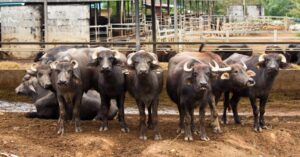

Cows exploited by the dairy industry are regularly subjected to artificial insemination to keep them pregnant and lactating, which is a distressing forced procedure.
Mammals only produce milk after giving birth and while their offspring are still nursing, so for cows of the dairy industry to produce milk, they must give birth constantly as their calves are removed from them soon after being born. They are often forced to be pregnant again when they would be still producing milk for their previous calf. Despite all technological advances, no cow has been genetically modified or manipulated in such a way that it does not need to be pregnant and give birth to produce milk.
When humans domesticated cows from wild oxen in the Near East some 10,500 years ago, they began controlling their breeding, which eventually created the multiple breeds of domestic cows we see today. This caused them a lot of suffering because, initially, they were prevented from choosing the mates they liked and were forced to mate even if they did not want to. The industry then began forcing the cows to be pregnant more often (which stressed their bodies more and made them age sooner) via artificial insemination.
Cows are now inseminated artificially by a person who extracted the sperm of a bull through another form of reproductive abuse (often using electrical shocks to extract semen in a process called electroejaculation). Beginning when they are around 14 months old, dairy cows today are artificially impregnated and kept on a constant cycle of birth, milking, and insemination until they are killed when they are 4 to 6 years old — when their bodies begin to break down from all the abuse, which is approximately 15 years premature.
The “Rape Rack”
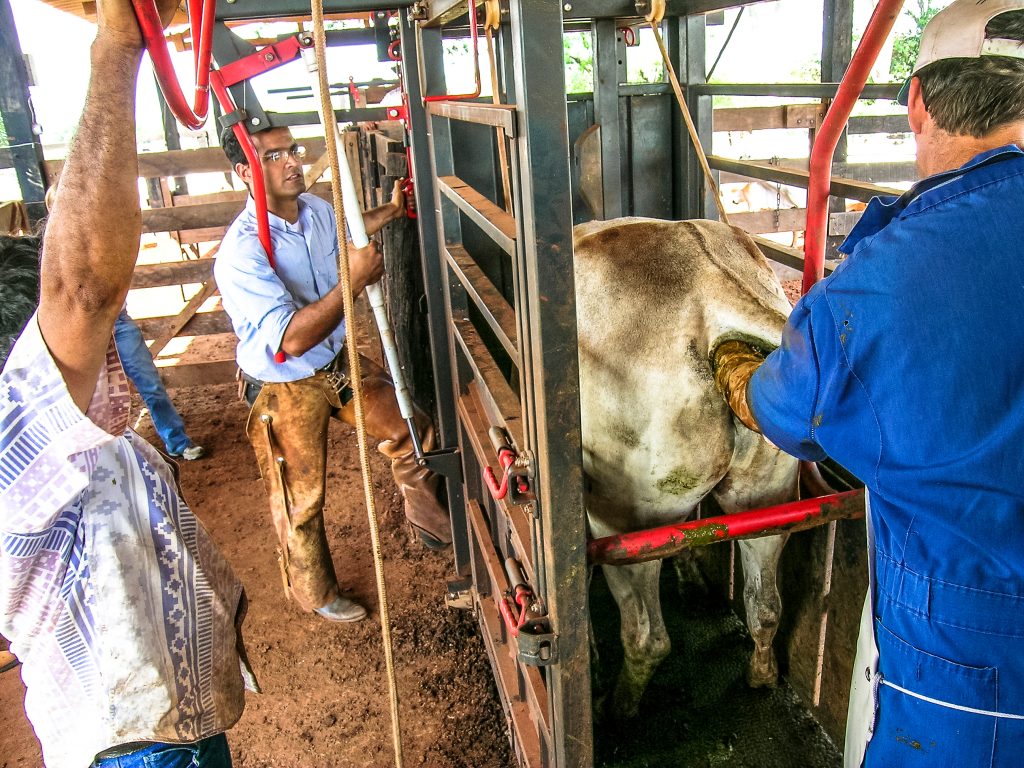
We apologise for the use of the word “rape” as we are aware of the potentially triggering effect it has. This is a term claimed to have been used by animal exploitation industries, referring to devices used to restrain animals during artificial insemination or other invasive procedures — the use of the term somehow “admitting” that what they are doing resembles this type of sexual abuse.
Dairy farmers typically impregnate cows every year using a device that used to be called a “rape rack”. This is defined as “a device for restraining an animal, in experimentation or the dairy and meat industry, so that it can be artificially inseminated or mated with by another animal.” Another term used is “stanchion.”
To impregnate the cows, farmers, their staff, or vets jam their arms far into the cow’s rectum to locate and position the uterus, and then force an instrument into their vagina to impregnate them with the sperm previously collected from a bull. The rack prevents the cow from defending herself from this violation of her reproductive integrity.
Kathy Stevens, the Executive Director of Catskill Animal Sanctuary, said this about the term “rape rack”: “As public awareness of its barbaric practices increases, the dairy industry is desperate to whitewash them. They can call this practice ‘artificial insemination’ if they wish, but impregnation against one’s will using forcible restraint pretty much sounds like rape to me.”
Not surprisingly, the term “rape rack” has been used less and less by the dairy industry (some of its members never admitting it was ever used), which has been increasingly keen on deceiving the public, so this type of “honest” term no longer fits the image the industry wants to portray. Katie Arth from PETA said this about the term: “It used to be common parlance in dairy farming. Today, farmers are far more savvy about terminology—as are other industries that use animals. As a result, that term has vanished from the farmers’ vocabulary in the same way that ‘iron maidens’ and ‘restraint chairs’ have been renamed ‘sow stalls’ and ‘gentling devices.’ The industry now prefers to use euphemisms such as ‘breeding boxes’ to describe the boxes or chutes where female cows are restrained while a worker forcibly inseminates them.”
Artificial Insemination in Cows
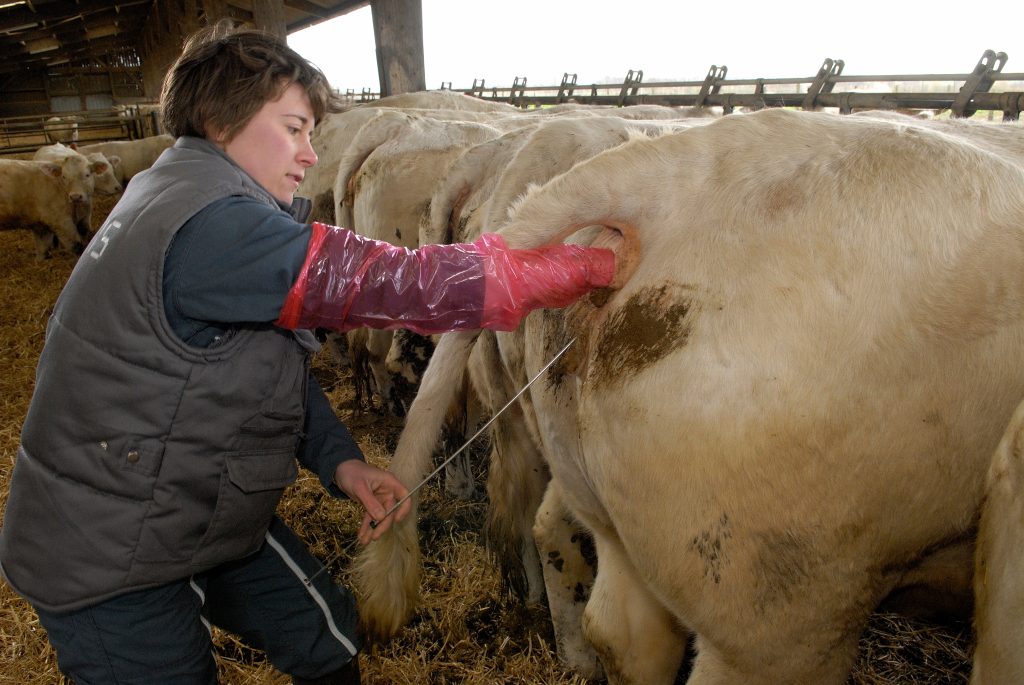
Since 1938, dairy farmers have been forcibly impregnating cows to produce more milk during their short lives at their farms. Artificial Insemination is abbreviated as AI, but due to the fact this abbreviation now generally means Artificial Intelligence, it may no longer be used for this procedure. During this practice, a dairy worker or vet inserts one of his arms (wearing a long plastic glove) into the rectum of a restrained cow in the “rape rack”, and with the other arm inserts a rod-like device called an AI gun into her vagina. The AI gun, which contains the bull’s semen, is pushed in further until it reaches the cervix. The semen is then injected into the uterus, and the cow will then get pregnant.
The procedure could be carried out incorrectly if not done by properly trained staff. According to the University of Minnesota, the AI gun should be inserted into the cow’s vulva upwards at a 30° angle to help prevent the gun from accidentally being inserted into the bladder. When the gun is 6 to 8 inches inside the vagina, the rear of the gun should be raised to level position and should be slid forward until it contacts the beginning of the cervix.
In the UK, the laws that stipulate how this procedure should be undertaken are the Veterinary Surgery (Artificial Insemination) Order 2010, and the Artificial Insemination of Cattle (Animal Health) (England and Wales) (Amendment) Regulations 1992. The regulations allow people who are not veterinary surgeons to carry out artificial insemination of cows, under certain conditions, as long as they are appropriately trained and licensed.
There are also strict regulations about how the semen of bulls is handled. In the EU, the laws that deal with this issue are Council Directive 93/60/EEC (which establishes health requirements for the import and intra-community trade of deep-frozen and fresh bovine semen), Council Directive 2003/43/EC (which requires that diluted semen be kept at a temperature of at least 5°C for at least 45 minutes after being added, and the Commission Implementing Regulation (EU) 2021/403 (which provides model animal health certificates for bovine semen, oocytes, and embryos that are intended to move within the EU or enter the EU). Similar regulations can be seen in other countries and the different US states.
Don’t be the reason another animal suffers. Take the Pledge to Be Vegan for Life: https://drove.com/.2A4o