
The shearing of sheeps, although necessary in some breeds, is not the harmless procedure the wool industry wants people to believe.
Domesticating goats and sheeps (we use “sheeps” as plural, other than “sheep”, as we write in veganised language) has been part of human culture for millennia. These animals were the second domesticated animals “created” by humans via artificial selection from wild species, only after dogs. The purpose of the domestication might have been mixed, as they were used to produce milk, meat, and also fibre for clothes — which we now call wool. The term “wool” is used to describe the fine, soft curly or wavy hair forming the coat of sheeps, goats, alpacas, vicunas, rabbits, or similar mammals, especially when removed and prepared for use in making cloth or yarn. These hairs, although biochemically no different than any other hair of mammals, have a different structure and density as they evolved in animals living in cold environments that need extra protection from heat loss.
The term “shearing” is the process of removing a sheep’s wool, and the person who shears the sheeps is called a shearer — a specialised profession within farming. Adult sheeps are typically sheared once a year. However, shearing sheeps is not like a simple haircut. It’s a more complex process that often causes suffering to the animals — which is one of the reasons vegans don’t wear wool.
Do Sheeps Need Shearing?

All breeds of domestic sheeps (Ovis aries) are descendants of the wild mouflon of Europe and Asia (Ovis orientalis), which still exist today and do not require shearing since they lose their excess hair naturally.
The wool industry started by learning how to remove the hair from these sheeps without killing them, but it became a fully-fledged industry when people learnt to genetically engineer sheeps (domestication of any animal is a basic form of genetic engineering). Between 11,000 and 9000 BCE, the peoples of Mesopotamia began to raise sheeps selectively, gradually altering their genes over generations to make them produce more hair. That led to today’s breeds that grow dangerous amounts of hair (as it can overheat the animal and facilitate parasitism) that need to be cut off periodically. Their shearing is only necessary because the wool industry has genetically manipulated and deformed them so much that intervention is now required for their health.
However, the industry could breed sheeps with normal amounts of hair, as there are breeds today that do not need shearing (such as the Katahdin, Dorper, American Blackbelly, St Croix, Romanov, Blackhead Persian, West African Dwarf and Red Maasai), but if it decides not to, the industry is responsible for the suffering of its sheeps. Therefore, what has defined the wool industry over centuries has been the genetic manipulation of sheeps to produce unnatural and unhealthy amounts of hair, which is an act of cruel exploitation, and explains why vegans oppose this industry.
The Suffering of Sheeps During Shearing
Shearing causes suffering because, in the wool industry, it is typically done very quickly by shearers who are contractors paid per fleece (or per its weight), not per hour of work, and are therefore likely to rush, treating animals very roughly and often causing them injuries and bleeding. Some shearers (known as Gun Shearers) can process up to 400 sheeps in a day, and they aggressively pin them down to prevent them from moving around — which is scary for them and hurts them. Some sheeps resist more than others, so the impatient shearers may hit them and stomp on their heads to keep them still.
Numerous undercover investigations by the animal rights organisation PETA have exposed these violent practices in several countries, including Australia, where most of the world’s wool comes from (Australians use the Merino breed, which is the most aberrant breed with the most excess hair).
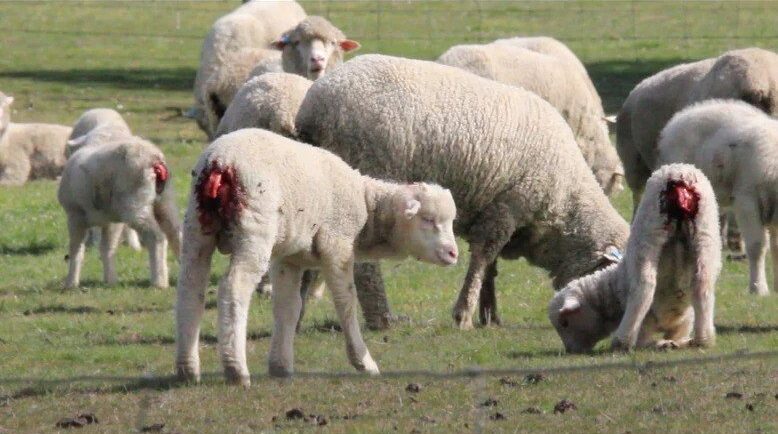
These investigations have also exposed the practice of mulesing: carving huge pieces of skin from sheep’s backs to prevent flystrike, a myiasis disease where flies lay eggs in the folds of the skin and maggots eat the animals alive. The combination of the Australian humid climate, and the Merino sheeps who have a lot of wrinkles in their skin, causes the retention of moisture, making them highly vulnerable to parasites. It was in the 1920s that John Mules invented mulesing (hence the name) in response to regular outbreaks of flystrike in Australia. The idea was that the resulting wound caused by cutting off strips of skin, when healed, creates an area of bare, stretched scar tissue with no folds or wrinkles to hold moisture and faeces, making it less likely to attract blowflies.
When lambs are just 6 to 12 weeks old, they are restrained on their backs, and then strips of skin are cut away from their backside (crescent-shaped flaps of skin from around a lamb’s breech and tail). Lambs may also have to experience tail docking, castration (removing testicles in ram lambs), ear tagging, and vaccinating at the same time mulesing is performed on them, making their suffering even more intense. In 2018-19, around 11 million Merino lambs were marked in Australia with the majority of these lambs being mulesed.
Mulesing causes lambs a great deal of pain (which can last from at least 48 hours up to several weeks), fear, and stress, and it’s currently still legal to carry out this procedure without any form of pain relief. Mulesed lambs will socialise less, lose weight in the first two weeks post-mulesing, and show behavioural indicators of pain. Although flystrike can be treated chemically, mulesing is still common in Australia.
The RSPCA in Australia, even if it is an animal welfare organisation that does not oppose the wool industry, does oppose the practice of mulesing, and even the breeding of Merino sheeps. On its website, it says, “The RSPCA believes that it is unacceptable to continue to breed sheep that are susceptible to flystrike and therefore require an ongoing need for mulesing or other painful procedures to manage flystrike risk.” The animal protection organisation Four Paws has also been campaigning against mulesing and it has been running a petition on this issue.
Because of all this campaigning, the Australian wool industry committed to phasing out mulesing by 2010, but this commitment was abandoned in 2009. In 2017, some companies in the industry, such as Textile Exchange and H&M, initiated the “Responsible Wool Standard” to exclude mulesing and help make the wool supply transparent and traceable, but this is not enough. Mulesing is just one of the causes of suffering of the sheeps exploited by the wool industry, so the only ethical option is to stop consuming wool from any animal and instead use any of the many non-animal alternatives that exist. Many retain heat very well, are easy to make, and are often cheaper. Such ethical alternatives come not just from synthetic plastics (which could be recycled), but also from sustainable natural fibres, such as Tencel (or Lyocell) made from wood cellulose, hemp, organic cotton, soya bean fibre, linen, bamboo, Woocoa (coconut and hemp fibre) and Nullarbor (created by bacterial fermentation).
Sign the Pledge to Be Vegan for Life: https://drove.com/.2A4o